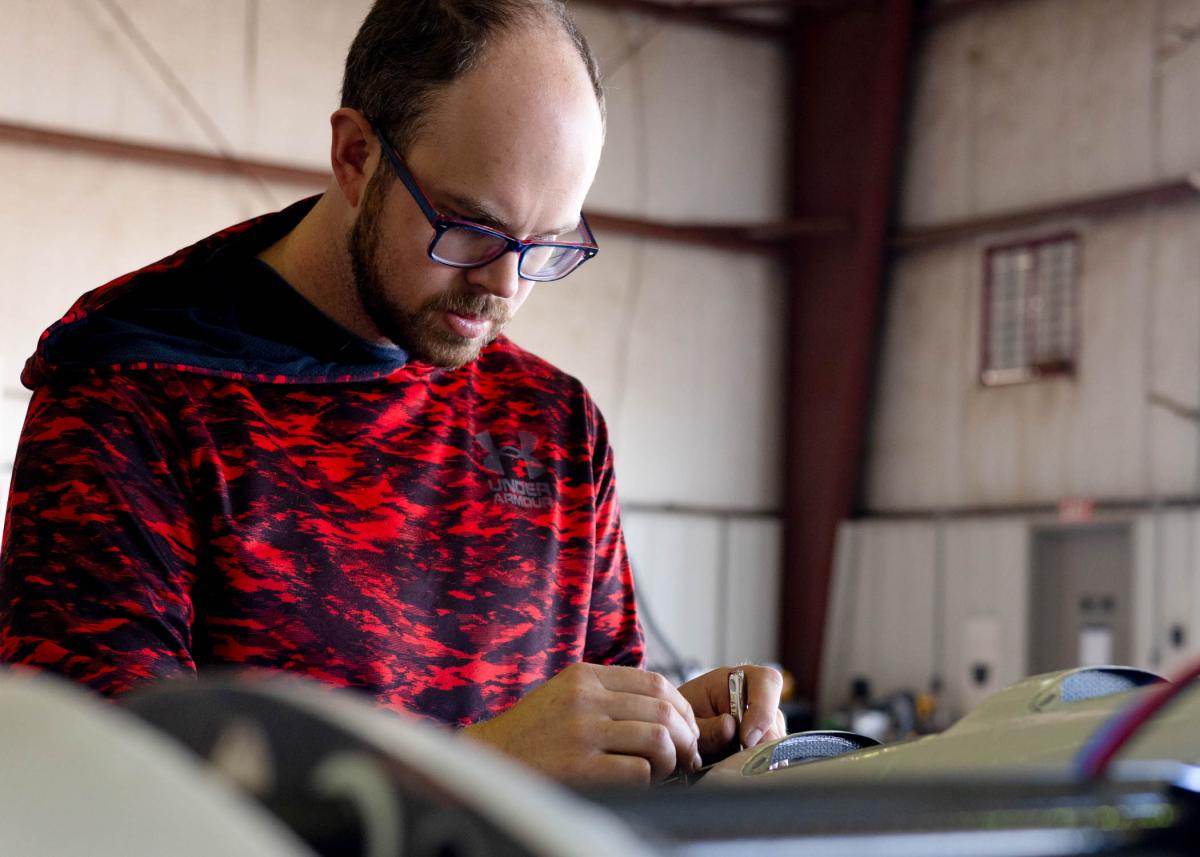
The names of the developmental aircraft would make a meteorologist smile: Squall, a 40-pound drone; Cyclone, a 330-pound unmanned aerial vehicle; and Venturi, a four-passenger plane envisioned as an air taxi of sorts.
Squall should be available to consumers by next fall, while experimental versions of Cyclone and Venturi are a few years away, according to Fuller.
All three aircraft incorporate the channel wing technology and design patented by Hop Flyt. The four channels are semicircular wings with the propellors and motors at the rear. The channels are attached to standard straight wings but rotate separately from the wings: up for takeoff and hovering and forward for fixed-wing flight.
In describing the intricacies of the aircraft, the enthusiastic Fuller – a native of Dimock in Susquehanna County – sounds like a veteran aerospace design engineer. That fluency developed over time, thanks in part to his Penn College degree, which exposed him to various computer-aided design programs.
“Coming into Hop Flyt, I didn’t have to learn how to use a CAD program. I could easily pick up on other software and build off that initial knowledge,” he said. “I felt like I had a good solid foundation, and from there, through self-study, I could build upon it to fit more into the aerospace and aviation side.”
The combination of taking an AutoCAD class in high school and fixing mowers as part of his lawn care job at a cemetery led Fuller to engineering design at Penn College.
“Seeing those tiny components inside of an engine, how that is all modeled as an assembly, how it all works together, I took that interest in small engines and interest in AutoCAD and found Penn College,” he said. “They offered pretty much exactly what I was looking for.”
Specifically, Fuller wanted hands-on CAD experience from day one.
“Instead of learning about it (CAD) in theory, doing it in the environment was very appealing,” he said.
But Fuller’s first two years in college were a bit aimless. He performed well in most of his engineering design courses but slacked off in other required classes and electives. And near the end of his sophomore year, Fuller’s father, who worked for Penn State Extension, died unexpectedly.
“I was goofing off and needed to change,” he admitted. “It was because of my father that I had the privilege of a tuition discount to attend a Penn State-affiliated school. I felt ashamed that I was not taking advantage of this opportunity and performing to my fullest potential. I wanted to make him proud even though I knew he wasn’t going to be there in person to see me walk the stage.”
Guidance from Katherine A. Walker, assistant professor of engineering design technology, also inspired Fuller.
“Mrs. Walker sat me down and was concerned. She really cared about how well I was doing and my well-being,” he recalled. “She was a really big influence on me and steered me in the right direction.”
“It is tough when a student encounters any kind of setback, but the death of a parent can be enormous,” said Walker, who retired last year. “Clark connected with his professors and knew how much they cared about him accomplishing his goals and wanting him to carve out a successful future. I do believe that foundation helped Clark with finding his way after his dad’s passing.”
Fuller made the Dean’s List as a junior and a year later graduated with a 3.67 GPA in his major and an overall GPA of 3.21.
“He was resilient, got back on track and accomplished his academic goals,” Walker said.