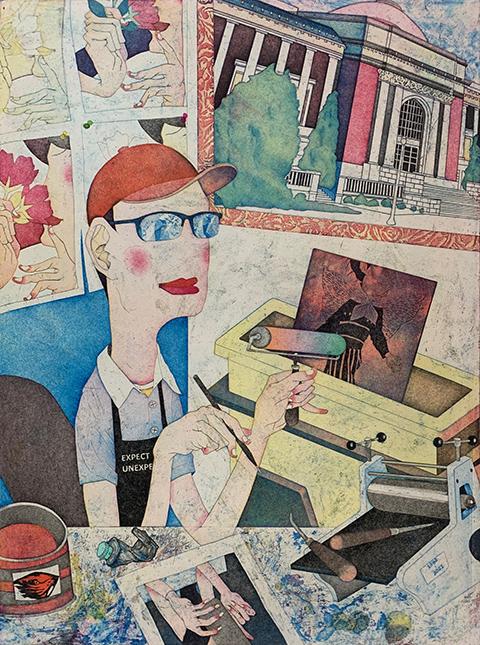
Hiratsuka’s printmaking method is specific to the artist because he uses one plate to print four colors instead of using one plate per color. Between each color, he sands all of the work off the plate and prepares the areas for the next color. The paper must dry for several days between each color printing, so each print takes roughly one month to complete. None of his work can be reproduced. His prints bear a slight resemblance to traditional Japanese ukiyo-e prints, which are frequently flat, bright and decorative.
“With continuous alterations to the copper plate, I print a sequence of black, yellow, red and blue, passing the same plate through the press for each design and color change,” Hiratsuka explained. “To start, the first tones to the plate are given with line etching, drypoint, aquatint, soft ground, photocopy transfer or roulette. I pull my first color. With these first impressions, I work back into the plate with a scraper, burnisher and emery paper to enhance the lights and accent the motif. I then go on to the second, third and fourth colors. Finally, the print is completed from the back with a relief process of woodcut or linocut to intensify shapes and/or colors. I print on the paper that best suits my work: a thin Japanese paper known as toyama kozo (mulberry).
“As in the French use of chine collé, I apply glue to the back of the kozo print and pass it through the press, with a heavier rag paper beneath. What the viewer sees is my four-color intaglio print saturated with subtle tones that come through the back of the toyama kozo paper, which is set deep into a rag paper.”
Combining his native Japanese culture with his current life in the U.S., Hiratsuka’s figures express contemporary aspects of the Western Hemisphere and are simplified or exaggerated, engaging with various elements such as flora, fauna, pop culture, anime, furniture and fashion. The artist employs a strong sense of humor and symbolism and is interested in expressing human moods and thoughts.