Penn College News

Aviation influencer attends Lycoming Engines Service School

Friday, May 8, 2026

photos by Alexandra Butler, photographer/photo editor

 title=

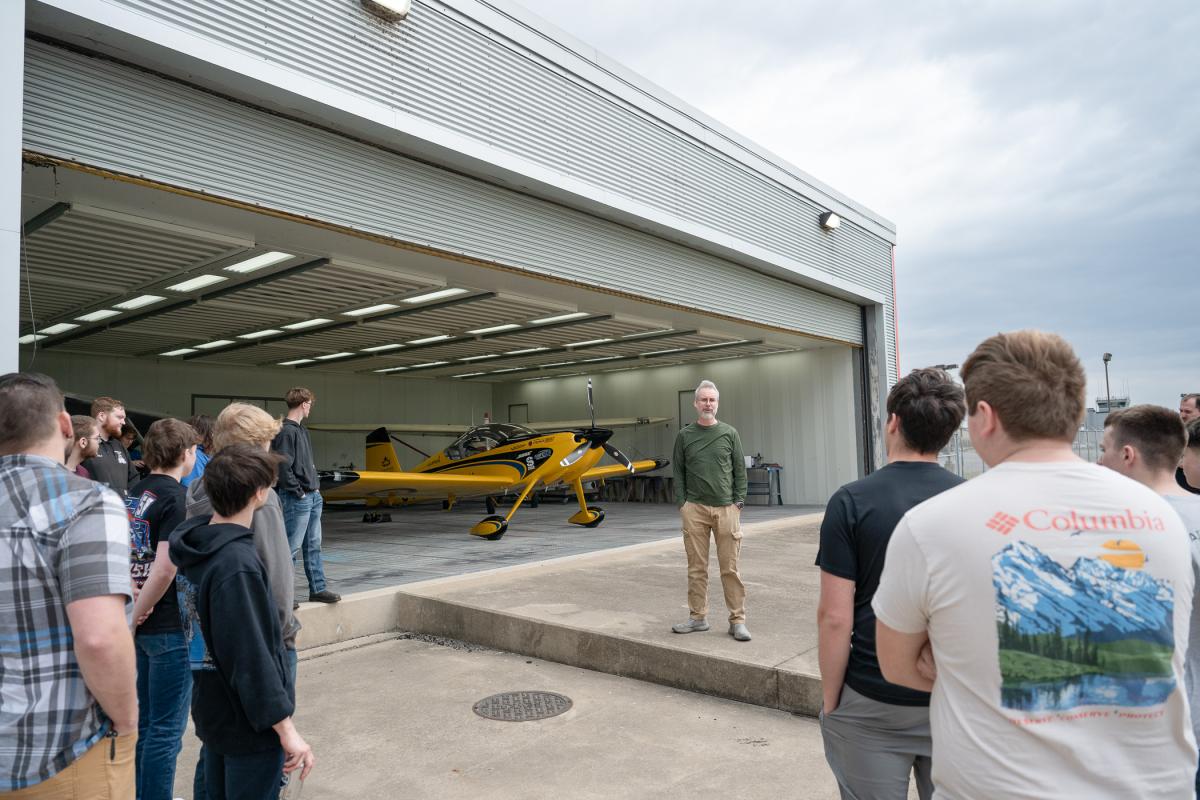
Social media influencer Steve Thorne shows his home-built Van’s RV-14 at Pennsylvania College of Technology’s Lumley Aviation Center. Thorne recently attended the Lycoming Engines Service School, offered at the center through Penn College Workforce Development.

Social media influencer Steve Thorne recently spent a week at Pennsylvania College of Technology as a student of the Lycoming Engines Service School, offered through Penn College Workforce Development. While in Williamsport, the private pilot also visited the Lycoming Engines factory, interacted with aviation students and created content for his channels.

Thorne arrived at the Lumley Aviation Center in his home-built yellow Van’s RV-14, which was housed at the Penn College hangar for the week. The aircraft, which he uses for transportation and aerobatic competitions, is powered by a Lycoming YIO-390-EXP199 piston engine.

Enrollment in the 40-hour internationally attended training program allows participants to better understand their engines and systems. Over the course of five days, students receive a review of Lycoming service publications and manuals and learn about construction, theory of operation and servicing of Lycoming reciprocating engines, as well as inspection, servicing and troubleshooting of related components. The training hours can be applied toward the Federal Aviation Administration’s requirements for Inspection Authorization renewal.

Thorne was just a young child when he knew he wanted to be a pilot. He fondly remembers stories about his grandfather’s World War II Spitfire. Although the family patriarch passed away before he could ask him questions, the general memories and impressions had a huge influence on Thorne’s personal journey with aviation. And now, with nearly half a million total followers across multiple social media channels, the Flight Chops creator has become an influencer in his own right.

Through Flight Chops, Thorne creates virtual “ride-along” video content for self-analysis and shares it on Facebook, Instagram, X, Threads and YouTube. He films his flights to analyze what went right, what went wrong and what was learned – to “practice, review, improve.”

“The Flight Chops channel has opened up a lot of amazing opportunities to capture and share various aspects of aviation a typical pilot wouldn’t have easy access to,” Thorne said. “I’m thankful for all of the opportunities that I’ve been able to capture and share via the Flight Chops project.”

The private pilot recalled a few memorable events that he was lucky enough to experience.

“Being rescued by a Coast Guard helicopter from the open water of Lake Michigan in the fall – five times in a single day,” he said. (Thorne was immersed in a training weekend and was “the duck,” running through several different hoist rescue scenarios.)

He is proud to have had his T6/Harvard check out – or qualification flight – and he was able to continue to build time and proficiency in the trainer that prepared pilots like his grandfather to fly World War II fighters such as the Spitfire and P-51 Mustang. He completed a week of float training that culminated in being checked out in a De Havilland Beaver on straight floats in Alaska. He captured and shared the entire process of building the RV-14, a sport aircraft designed for civilian pilots, and he learned to fly aerobatics and gained enough proficiency to not only share the experience with passengers, but also compete at the sportsman level over several seasons, scoring a personal best of 81% on the final flight of the recent series.

“Not sure I’ll be able to top that, but I’ll be trying next season!” he said.

As a pilot sponsored by Lycoming Engines, it made sense for Thorne to attend the classes offered through Penn College Workforce Development.

“My goal was to learn more about my engine and become more well-informed when doing inspections,” Thorne said. “It was great to get a deep dive into the technical information while also being hands-on. It offered the opportunity to remove the abstract and instead do real work on the engine.” 

 title=

Thorne interacts with Penn College aviation students while attending the Lycoming Engines Service School.

In its 30th year, the Lycoming Engines Service School began as a way for maintenance professionals, pilots, aircraft owners and experimental aircraft builders like Thorne to learn how to perform light service on four-cylinder Lycoming O-360 engines.

According to Kathy Wentzler, Workforce Development training specialist, the program combines theory-based maintenance instruction with hands-on experience, training students how to fully disassemble and reassemble an engine. Students also visit the Lycoming factory as part of the program.

Penn College, she said, is the only authorized training provider for the Lycoming Engines Service School.

“The partnership between Lycoming and Penn College in support of the service school, along with our shared commitment, is truly exceptional,” Wentzler said. “We offer 12 service schools annually – five in the fall, five in the spring and two in the summer – and the courses are consistently filled to capacity. During course registration, participants are warmly welcomed by Missy Fullmer, senior program specialist for the Lycoming Engines Service School. In addition, our instructor, Mike Damiani, provides training at EAA AirVenture Oshkosh during the summer air show.”

As the world’s largest manufacturer of aircraft piston engines, Lycoming Engines ensures that quality and safety are non-negotiable, said Christopher Gayman, OEM sales manager for the Williamsport-based plant and a 2010 graduate of the Penn College aviation maintenance technology program.

“The need for highly skilled maintenance professionals continues to grow,” Gayman said. “Like many aviation manufacturers, we face a significant talent shortage that threatens innovation, productivity and operational excellence. Sustaining our workforce requires individuals with strong technical capabilities, sound judgement, leadership potential and an entrepreneurial mindset.”

That, he said, is where Penn College comes in as a premier provider of talent and a nationally respected leader in applied technology education.

“We are consistently eager to recruit Penn College graduates because we know they bring hands-on proficiency, industry awareness and a strong cultural fit from day one,” Gayman said. “Penn College remains a strategic partner in the advancement of our mission and the continued success of our organization.”

More than 150 Penn College alumni – over 25% of the company’s workforce – serve in key roles at Lycoming Engines, but the partnership extends beyond hiring. Lycoming also participates in internship and cooperative education programs, serves on academic advisory boards, contributes to student scholarships and maintains representation on the Penn College Foundation Board of Directors. Lycoming Engines is a member of the Golden Society ($500,000-$999,999) on the college’s Donor Wall.

For more information about the Lycoming Engines Service School, call 570-327-4775.

To learn about the college’s aviation majors, call 570-327-4761.

For information about Penn College, a national leader in applied technology education, email the Admissions Office or call toll-free 800-367-9222.