Penn College News

Penn College students team up to make universal robotic gripper

Tuesday, April 21, 2026

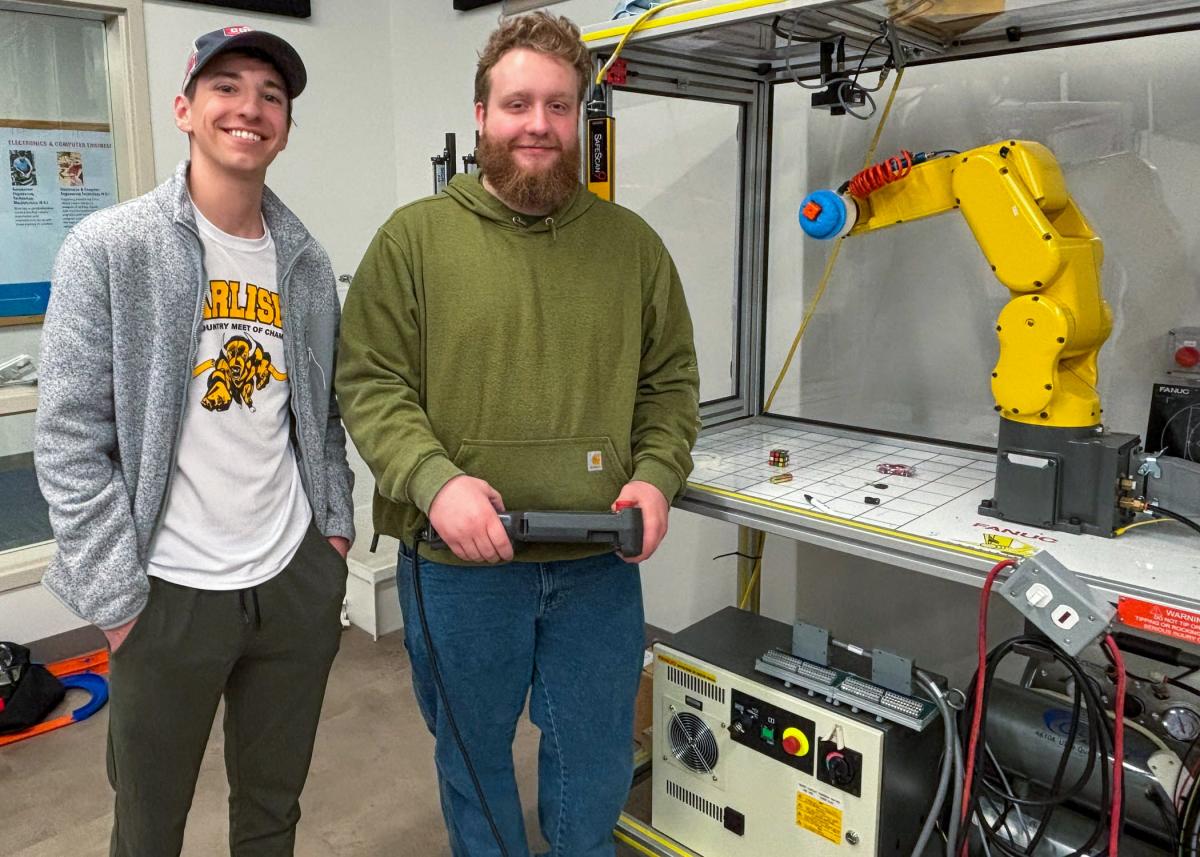
Pennsylvania College of Technology students Owen R. Arnold-Paine, of Lebanon (left), and Michael C. Carpenter, of Wellsboro, prepare to demonstrate the universal end effector that they made for their Robotic Applications class. Their end effector – a latex balloon sandwiched between two machined plastic body components – is connected to the arm of a Fanuc robot in the college’s Process Control and Robotics Lab.

Ken J. Kinley likes to pair students from different majors to tackle assignments in his Robotic Applications class at Pennsylvania College of Technology. The completion of a recent project validated his approach.

Michael C. Carpenter, of Wellsboro, studying automation engineering technology: mechatronics and seeking a minor in robotics, and Owen R. Arnold-Paine, of Lebanon, majoring in manufacturing engineering technology, combined their skills to produce a universal end effector, or gripper, during about a dozen hours of lab work.

“What they produced is above my expectations,” said Kinley, assistant professor and department head of electronics and computer engineering technology. “Their end effector can pick up various shapes and sort many different small items. You don’t need a tool changer. The flexibility of their gripper makes it unique.”

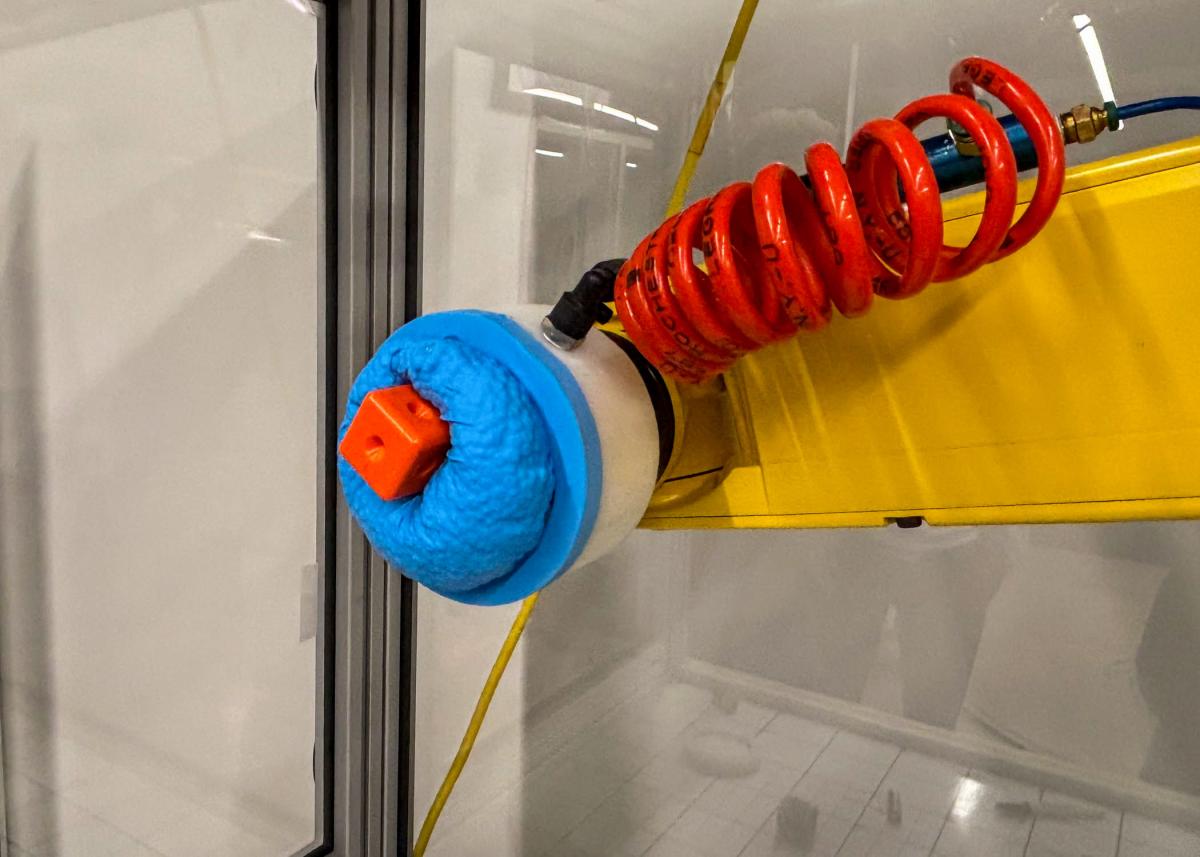
Their gripper is connected to the arm of a Fanuc robot in the college’s Process Control and Robotics lab. The assembly consists of a latex balloon – filled with plastic pellets – sandwiched between two machined plastic body components. Metric screws secure the gripper to the robot’s arm. When activated, the balloon portion of the end effector conforms to and gently engulfs an object, allowing the robotic arm to lift and move the item.

“As long as the object is small and light enough, our gripper can grab it,” Carpenter said. “We have an array of things we’ve tested.”

Those “things” include a marker, a small battery, and miniature versions of a toy car, a block and a Rubik’s Cube.

Throughout the course, students engage in basic programming and operation of robots. Manufacturing end effectors for different industrial applications requires them to dig deeper.

“He (Kinley) showed us the video of a (universal) gripper and wanted us to recreate it,” Arnold-Paine said.

“When we saw the video,” Carpenter recalled, “we thought to ourselves, ‘We don’t know how it works; we just see that it works. How are we going to go about doing that?’”

Combining complementary skill sets, that’s how.

“We put our brains together and designed it,” Arnold-Paine said.

The student-produced "gripper" moves a toy block.

That matter-of-fact approach brought a smile to Kinley’s face. “The best part of the class is having students from different majors collaborate and maybe do some cross-training,” he said.

While Carpenter and Arnold-Paine worked together on the design and manufacturing processes, each had their specialty. Carpenter focused on design issues, relying on Autodesk Fusion 360, an industry-standard 3D design software. Arnold-Paine used CNC mills and lathes in the Larry A. Ward Machining Technologies Center to make the gripper’s two-section body out of Delrin, a type of thermoplastic provided by the college’s polymer engineering department.  

“Originally, we had a third section that was done on a mill, but through our iterations, we were able to eliminate that part entirely,” Arnold-Paine said.

The discarded part was intended to be a plastic filter, preventing the pellets inside the balloon from being sucked into the robot’s vacuum system. The duo realized that putting the pellets in a mesh bag and inserting that bag into the balloon would be just as effective.

If they were to adapt the end effector for an industrial setting, the students said they would replace the balloon with a thicker sheet of latex. They also would machine the body out of aluminum, rather than plastic.  

“We used Delrin for the body because it was available and quicker to machine,” Carpenter explained.

Both are grateful for the experience and believe the project’s impact will go beyond the “A” they received for the assignment.  

“It’s a dream to do projects like this,” said Arnold-Paine, who has a summer internship lined up at a metal foundry in Cornwall. “We worked on something that could be taken into industry. The experience is something that will be useful when we leave college and get our jobs.”

Carpenter, who graduates in May, has secured his job. He’ll be a technical support group technician for Coty Inc. in Hunt Valley, Maryland.

“I’ve done a couple internships and worked with robots everywhere I’ve gone, but interfacing a design with the robot is something that I haven’t gotten to do until this class and this project,” he said. “It’s been awesome to be able to do this.”

To learn more about manufacturing engineering technology, automation engineering technology: mechatronics and other programs offered by Penn College’s School of Engineering Technologies, call 570-327-4520.  

For information about Penn College, a national leader in applied technology education, email the Admissions Office or call toll-free 800-367-9222.