This year’s Construction Management Competition began in December, when teams were sent a request for proposal, a document that outlined a construction project and asked teams to submit their bids and approach to the work. The project – a recent real-world construction project – was a health and wellness hub at MiraCosta College in Oceanside, Calif., that consisted of construction of a nursing and allied health classroom building, a full gymnasium and a Kinesiology, Health and Nutrition Building.
The students attacked the challenge, starting during fall final exams and sacrificing two weeks of their winter break to stay on campus.
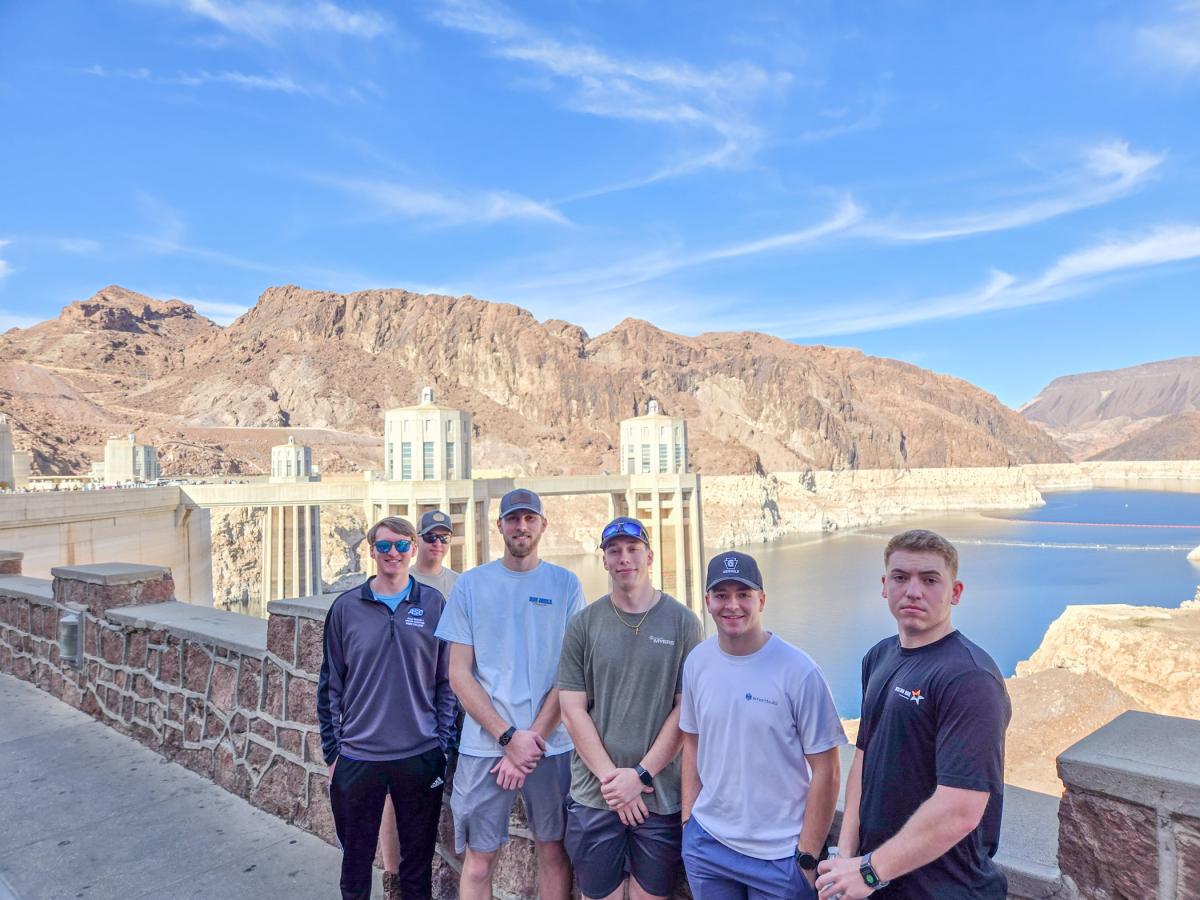
The team, comprising seniors Morgan H. Littlefield, of Columbia Crossroads (team captain), Chris A. Fisher, of Middleburg, and Noah H. Jumper, of Shippensburg, and juniors James C. Fretz, of Collegeville, Aaron A. Almony, of Bel Air, Maryland (alternate), and Jason Wiedl, of West Pittston (alternate), formed a general contracting firm, naming it Casino Construction Inc. to honor a 20-year tradition of Penn College teams bearing the CCI initials.
To complete the first phase of the competition, the team devoted 40 to 50 hours outside of class each week.
Tasks included a full quantity takeoff and estimates, site utilization and project management planning, construction and preconstruction planning and scheduling, quality control process, and a site-specific safety plan.
“These tasks were broken down amongst the team, but it always comes back to the whole team understanding and coordinating all of the pieces,” Littlefield said. “We spent a lot of time ensuring we were all on the same page, even getting heated occasionally as we challenged each other. That is one of the unique aspects of opportunities like the competition: It becomes very real.”
The students turned in their proposal documents for Step 1 on Feb. 23 and continued to prep – as best they could – for Step 2: “addendum day” in Las Vegas.
“It’s a five-hour challenge where they throw changes at us, and we have to revise what we submitted,” Fisher explained. “They really test us on how well we know all of the details.”
The addendums included challenges created by the judges, plus some that the real-world construction management firm had to tackle: the addition of a 600-stall parking lot and developing an alternate plan – to be implemented in four days – for students to get across campus when a pedestrian bridge near the building project was struck by a vehicle.
After submitting round two proposals, the judges reviewed teams’ Step 1 and Step 2 submissions to “short-list” 10 teams to move on to Step 3 the next day. This entailed a 10-minute presentation of their proposal in front of the competition’s 30 industry judges – some who were part of the MiraCosta College project – as well as a hundred or more spectators, followed by 15 minutes answering project-specific questions.
“We had prepared our presentation in advance, but that night we were up until 2 a.m. changing, practicing and nitpicking the details,” Jumper said. “We did a good presentation. It was an amazing learning experience.”
After Step 3, teams participated in the convention, had a debrief with the judges and enjoyed Las Vegas until the ABC Careers in Construction Awards ceremony.