“There’re billions of dollars of work that needs to be inspected. But there just are not enough people who have that skill,” Webb said.
While it has offered some NDT classes since the mid-1980s, Penn College began the NDT associate degree major in Fall 2022. The initiative was part of a three-year, $599,816 National Science Foundation grant devoted to advanced technology education in fields that drive the economy (NSF Award 2000831).
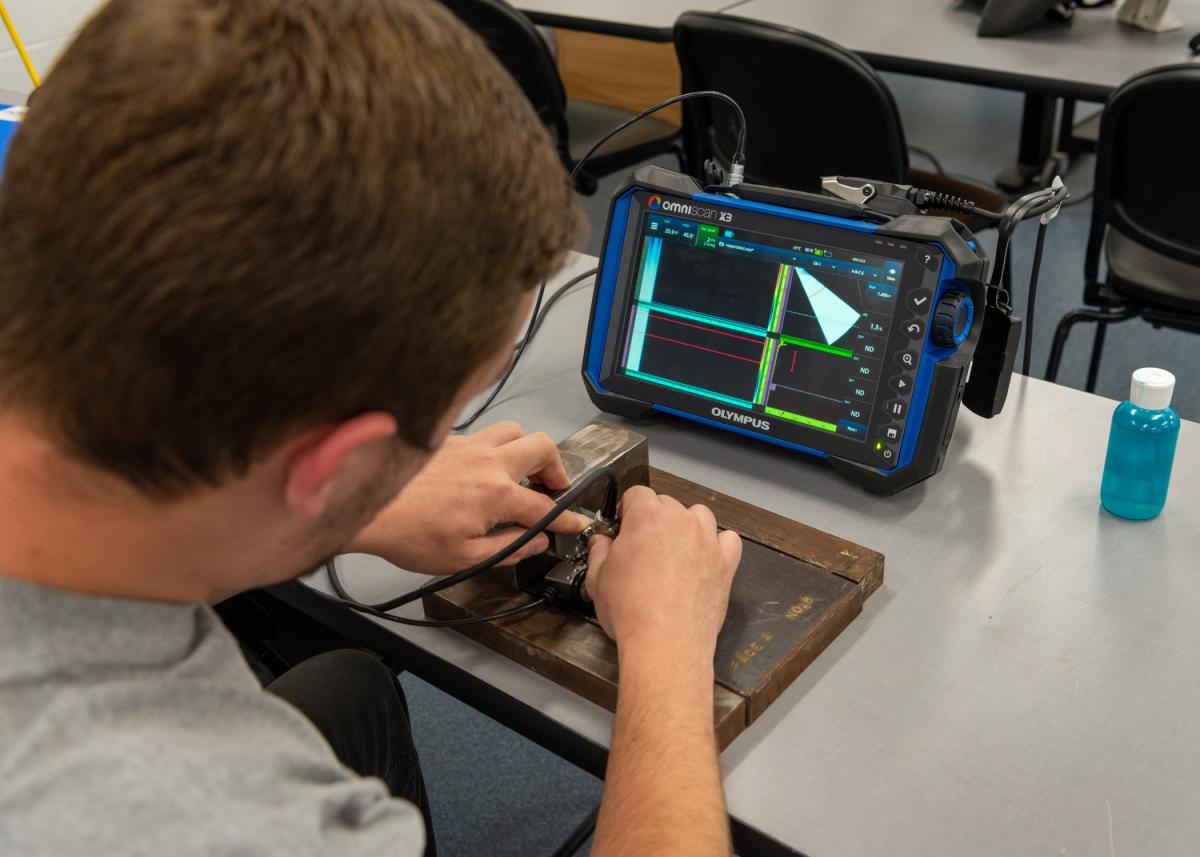
The college purchased industry-standard equipment to enhance practical experience for students in a variety of NDT processes: radiographic, ultrasonic, phased-array ultrasonic, magnetic particle, liquid penetrant and visual inspection.
“Our degree is unique in that we’re giving students hours of training. They know how to use the equipment. They know how to inspect parts and accept and reject parts,” said Michael J. Nau, a welding instructor and former Level II radiographic NDT inspector. Nau and James N. Colton II, assistant professor of welding, developed the NDT curriculum.
The NDT degree is intertwined with Penn College’s welding program. NDT students learn welding basics in the college’s 55,000-square-foot lab before using their NDT skills to test the work produced by welding majors.
“NDT and welding go hand-in-hand. Most every weld that’s put down – by code – has to be inspected. So that’s where our niche is,” Nau explained. “Our students can inspect welds visually and with non-destructive testing.”
Zach A. Snyder, of Kintnersville, and Madison T. Holland, of Montoursville, are two of several students who are combining the NDT associate degree with a bachelor’s degree (welding & fabrication engineering technology for Snyder and applied management for Holland).
“NDT is just fascinating to me. Getting to do radiation work and this UT (ultrasonic) work, we get an in-depth view of what’s going on inside that weld,” Snyder said. “It’s no longer, ‘Oh, it looks good on the outside.’ I know what’s happening inside.”
“I love how we have hands-on experience with the welding students,” Holland added. “We give practical examinations to the students, and then we test their plates. And we send it back to them like a real welding exam, so it gives us some experience for the field.”
Graduates of the NDT associate degree earn essential classroom hours toward American Society of Non-Destructive Testing certification in both radiographic and ultrasonic testing, the two most common NDT procedures. The college also offers a one-semester competency credential for either method. ASNT certification is achieved following on-the-job training.
“Depending on whether you want to work out in the field traveling (for an inspection company) or whether you want to work in-house somewhere, there are two different avenues you can take,” Nau said.