On the ‘road to space’

Grad’s career ‘takes off’ with Blue Origin

Penn College Magazine Spring 2026, Volume 35, Number 1

Thomas Speicher

by Thomas Speicher

Writer/Video Producer

Dwight D. Alexander does more than live along Florida’s Space Coast. He contributes to the industry that gives the region its name, drawing on his industrial design degree from Pennsylvania College of Technology.

The 2017 graduate and Brevard County resident is a technical designer at Blue Origin Enterprises, the American space technology company founded by Jeff Bezos. Alexander creates and manages designs for aerospace components and systems. His responsibilities encompass conceptualizing design ideas, creating computer-aided design models and drafting technical specifications. 

“While I can’t discuss specifics, knowing those models and drawings help hardware leave Earth is humbling and motivating,” Alexander said. “It raises the bar for clarity and quality in everything I deliver.”

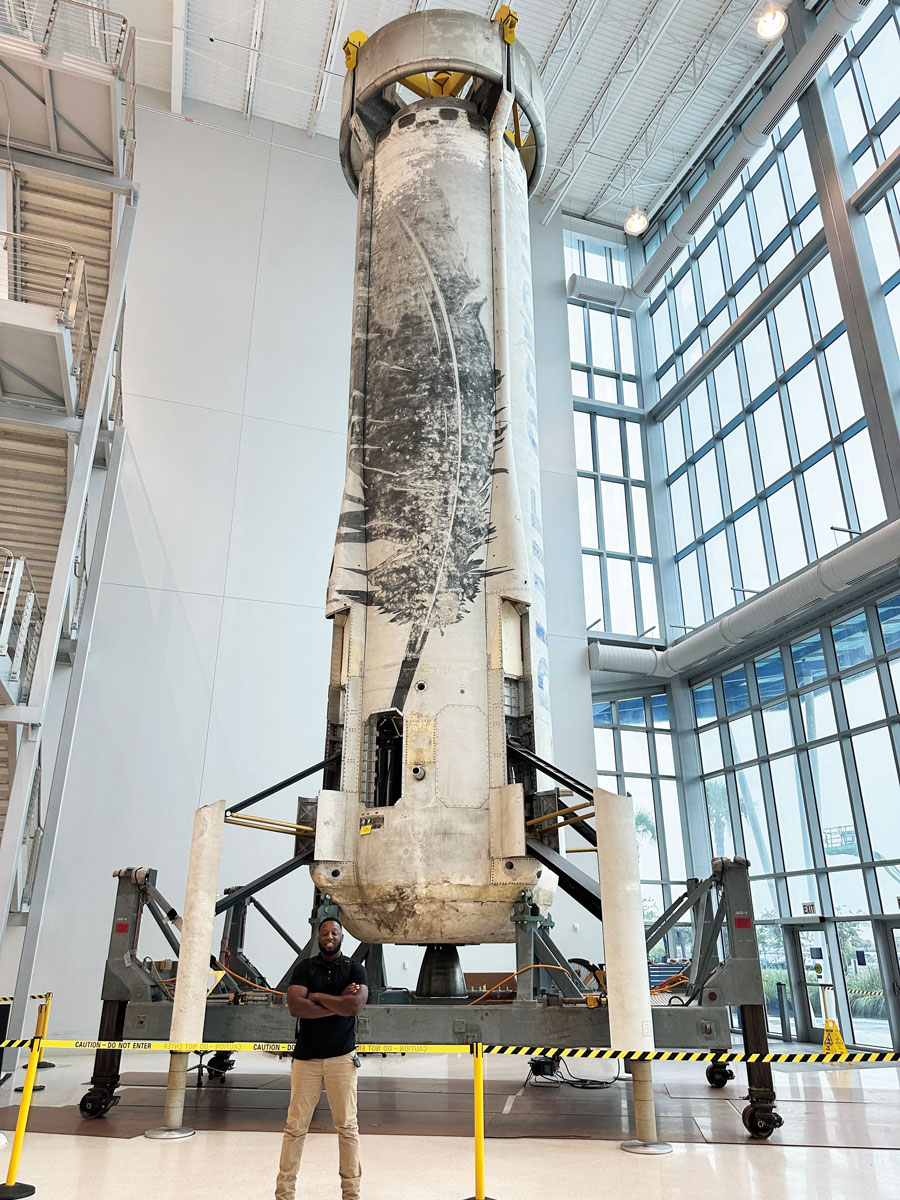
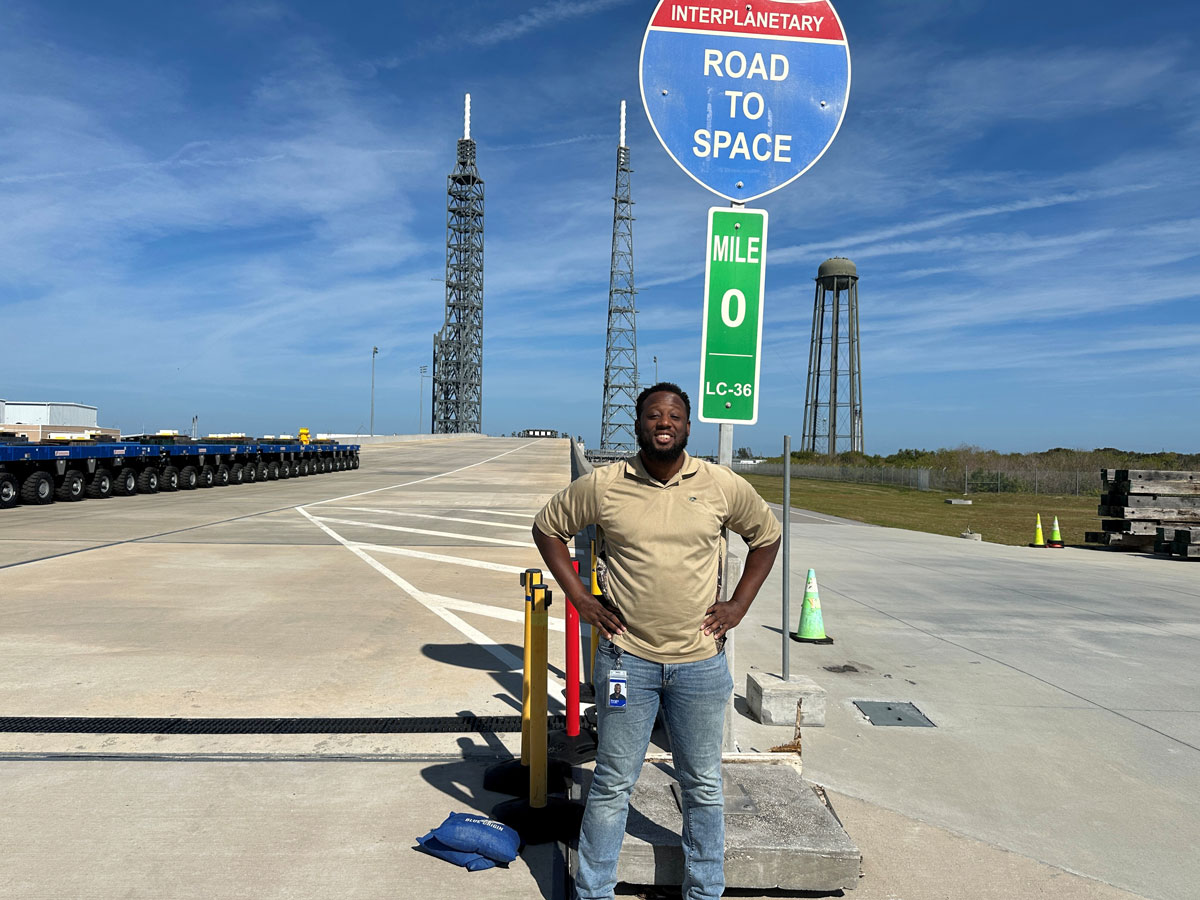
He works for Blue Origin at its Merritt Island complex, home to the manufacturing and launch facilities for the New Glenn rocket, a reusable rocket intended to deliver payloads to space. Blue Origin is also well-known for its New Shepard rocket, which is built for space tourism. Launched from West Texas, New Shepard has flown over 80 people past the Kármán line (62 miles above sea level), the internationally recognized boundary for space. 

Named after iconic astronauts, New Glenn honors John Glenn, the first American to orbit the Earth, and New Shepard pays tribute to Alan Shepard, the first American in space. 

On occasion, Alexander witnesses the literal power of those legacies. 

“Time seems to slow as everything snaps into focus,” Alexander said in describing Blue Origin launches. “You feel the vibration first, then an ocean of sound as precision and raw power move in sync. It’s visceral and inspiring every time. It’s a reminder why this work matters as we build a sustainable road to space.” 

“ Knowing those models and drawings help hardware leave Earth is humbling and motivating.”

The Florida native’s interest in aerospace and the tenets of industrial design first intersected in childhood. Aerospace fascinated him because it “sits at the edge of what’s possible.” And growing up, Alexander’s “handy” father repeatedly showed him that it’s possible to build what one imagines.

“Hands-on problem solving – paired with making things intuitive and human centered – pulled me into industrial design,” Alexander said.

Penn College was Alexander’s last visit on a tour of northeastern colleges and universities. Impressed by the passion and expertise of Thomas E. Ask, professor of industrial design, Alexander chose to enroll at Penn College.

“Dwight was aspirational in many ways. He was clever and could get things done,” the professor recalled. “He learned about a lot of the practicalities of designing objects. The art foundation courses guided him on how to think visually. Good things arise when you love to make the world a better place and you know how to work hard.”

Penn College exceeded Alexander’s high expectations as he immersed himself in his core courses and seized unique opportunities. He was one of 20 students worldwide to attend a workshop at Kobe University’s International Innovation Design School in Japan and completed a remote internship with Nexeon MedSystems, a global medical device company.

Alexander also flourished outside the classroom, playing intercollegiate basketball for two years and serving as secretary and treasurer of the student chapters of the Industrial Design Society of America and the Society of Inventors and Mad Scientists. He credits those experiences for developing the teamwork and time management skills that are fundamental for fast-paced engineering environments.

Following graduation, Alexander worked as a mechanical designer for a couple of companies before seeking and accepting in September 2024 an open spot in Blue Origin’s Entry Level Technical Designer-Rotation Program.

“It blends deep tool and process training with rotations across the product lifecycle,” he explained. “With a lead and mentor, I built proficiency in Creo (3D CAD software) and Windchill (a product lifecycle management system), learned Blue Origin standards, and supported structural, mechanical and routed systems work. The learn-apply-improve cadence fit my drive to grow and add value quickly – reducing rework, accelerating release quality and preparing me to lead change across teams.”

Today, Alexander is a mentor to the designers in the ELTDR program. He’s also enjoying turning “ambiguity into clear models, drawings and standards that remove barriers and empower teams. Turning complexity into repeatable, teachable workflows is both the challenge and the fun,” he said. “It’s key to reusability and rapid turnarounds.”

While he works over 1,000 miles away from the Penn College campus, Alexander said the lessons learned at his alma mater remain close to his heart. He relies on his education daily. 

“It provided a strong foundation in design principles, technical proficiency and problem-solving skills, which are essential for fulfilling duties effectively,” he said. “It equipped me with the ability to think creatively and develop designs that are both aesthetically pleasing and technically sound, which is crucial in the aerospace industry.” 

That’s an industry Alexander hopes to serve for years to come. 

“I want to keep growing as a technical designer and as a change leader – helping teams self-solve faster and accelerating our mission to build the road to space for the benefit of Earth,” he said. 

Spoken like a true resident of the Space Coast.