Senior Project Leads To Patent
Penn College Magazine Spring 2026, Volume 35, Number 1
by Thomas Speicher
Writer/Video Producer
In kindergarten, when Zachary C. Moore was asked what he wanted to be when he grew up, he offered a one-word answer: “inventor.” Thanks to his education at Pennsylvania College of Technology and personal fortitude, the lifelong tinkerer has fulfilled that childhood dream.
About a year after his May 2024 graduation, the U.S. Patent and Trademark Office granted a patent for the prosthetic socket Moore designed for his capstone project at Penn College, a semester-long undertaking required for the bachelor’s degree in engineering design technology.
“It is extremely rare for students to continue working on their capstone project following graduation, let alone pursue patent protection for their work,” said Craig A. Miller, assistant professor and department head of engineering design technology. “It is difficult to express how proud we are of Zachary. Achieving a patent is the pinnacle of success for so many engineers, inventors and entrepreneurs worldwide. The fact that Zachary has achieved this feat at such a young age only adds to the pride we feel.”
A prosthetic socket serves as the interface between the body and the prosthesis. The socket fits over the residual limb and holds the prosthesis in place, providing stability and allowing for controlled movement.
Not all sockets are created equal. As Moore wrote in his patent filing: “Poorly fitted sockets can cause discomfort, pressure points and skin irritation, leading to pain, blisters or pressure sores. Hard materials may not conform well to the limb, reducing comfort during prolonged use, while uneven pressure distribution can cause tissue damage. … Many sockets are designed for a fixed shape, failing to accommodate residual limb fluctuations.”
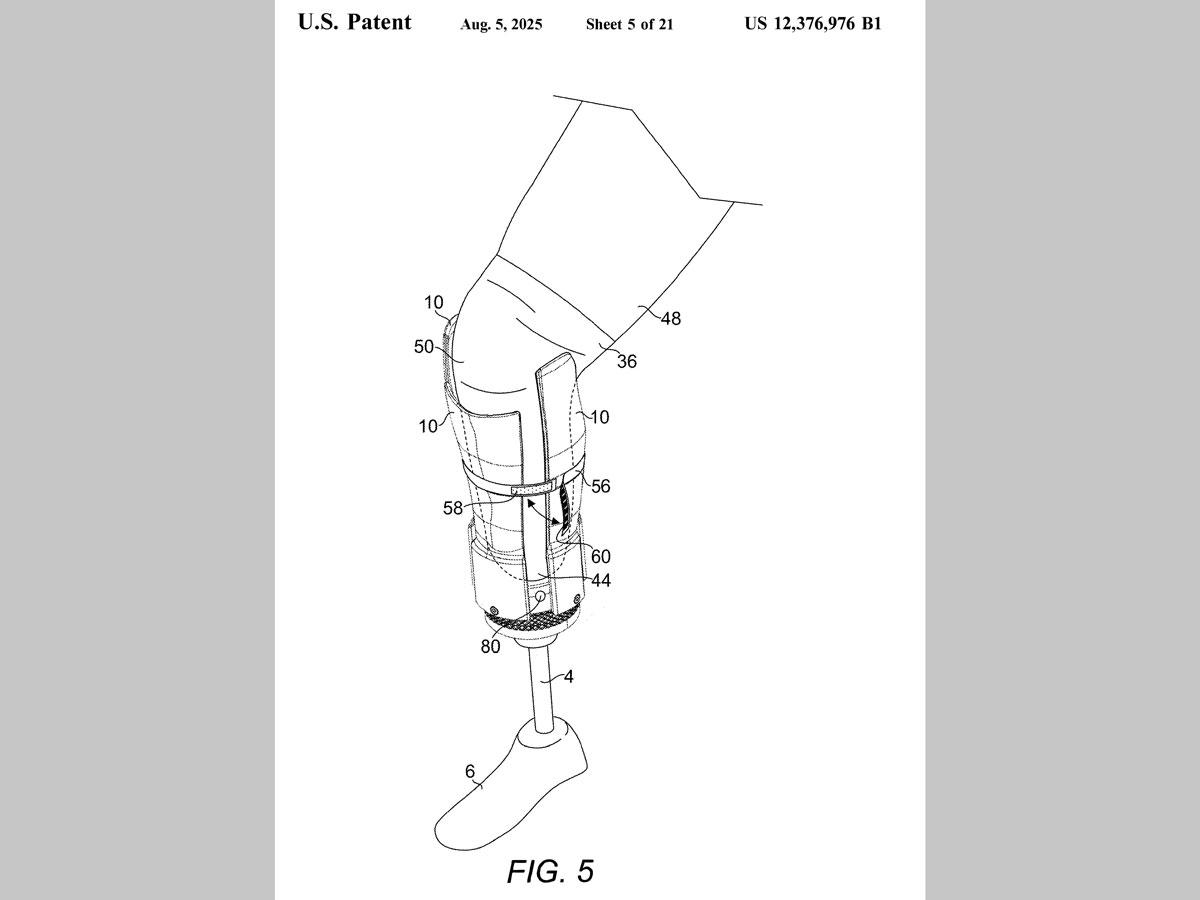
Moore patented a prosthetic socket with adjustable panels that secure the residual limb in place.
“ Achieving a patent is the pinnacle of success for so many engineers, inventors and entrepreneurs worldwide. The fact that Zachary has achieved this feat at such a young age only adds to the pride we feel.”
Craig A. Miller, assistant professor and department head of engineering design technology
A ratcheting mechanism – when rotated – moves the panels in or out in a straight line to either increase or reduce the socket’s opening. With the ability to easily adjust the fit of the socket, an individual can account for changes throughout the day in their limb’s fluid volume. For example, physical activity may cause the limb to swell and prompt the user to expand the socket’s aperture.
“The panels evenly distribute pressure to the entire limb while providing air flow through the gaps between the panels. The pin lock suspension system ensures a high level of prosthetic security, in that it won’t easily detach unless the user intends it to do so,” Moore explained.
The clock began ticking on the patent possibility once he shared a 3D-printed prototype of the prosthetic socket during his capstone presentation to faculty and classmates a few weeks prior to graduation. In the U.S., individuals have just a year to file for a patent after publicly revealing their invention.
Fortunately, a key capstone requirement – conducting exhaustive research to prove his version of a prosthetic socket didn’t exist – matched an essential step in the patent filing process. With that obligation complete, Moore – with the aid of a patent attorney – spent countless hours post-graduation writing in extreme detail how all parts worked, why the invention was useful and how it differed from existing devices. His written explanations were complemented by 23 black-and-white illustrations of device components.
The final stages of the application took months to complete because Moore was busy at his day job. Upon graduation, Hybridge Dental Laboratory in Rochester hired him as a dental CAD technician. The medical equipment manufacturing company specializes in full-mouth and full-arch dental restorations.
Moore saw the job opening on LinkedIn and responded by submitting his resume and capstone materials.
“Medical design was always something I wanted to do after graduation,” he said. “Considering the company is based around dental prosthetics, they were really interested in talking with me, given my educational background and capstone project.”
In his role, Moore designs and adapts a variety of different models and parts, including pre-op models that represent a patient’s current dental anatomy. Those models serve as quality control and allow doctors to visualize an upcoming surgery.
“Working with full-arch restoration cases every day provides me with a variety of dental anatomy to work on. No case is ever the same. It never becomes mundane or boring,” Moore said. “The company is always evolving, so there’s always something to learn.”
He grew up about 35 miles west of Hybridge Dental Laboratory in the quaint community of Albion, New York. From a young age, Moore remembers taking everything apart around his house in a quest to understand how things worked. His tinkering meshed with a rudimentary introduction to engineering design during a high school art class. A 3D printer in the room enticed him to discover the possibilities of computer aided design.
“I was instantly drawn to the 3D printer and proceeded to teach myself how to design things in any CAD software I could get my hands on,” Moore said.
An associate degree in mechanical technology followed from Monroe Community College. Moore planned to use that program as a springboard to an engineering design baccalaureate degree at a private university in New York but changed his mind after discovering Penn College.
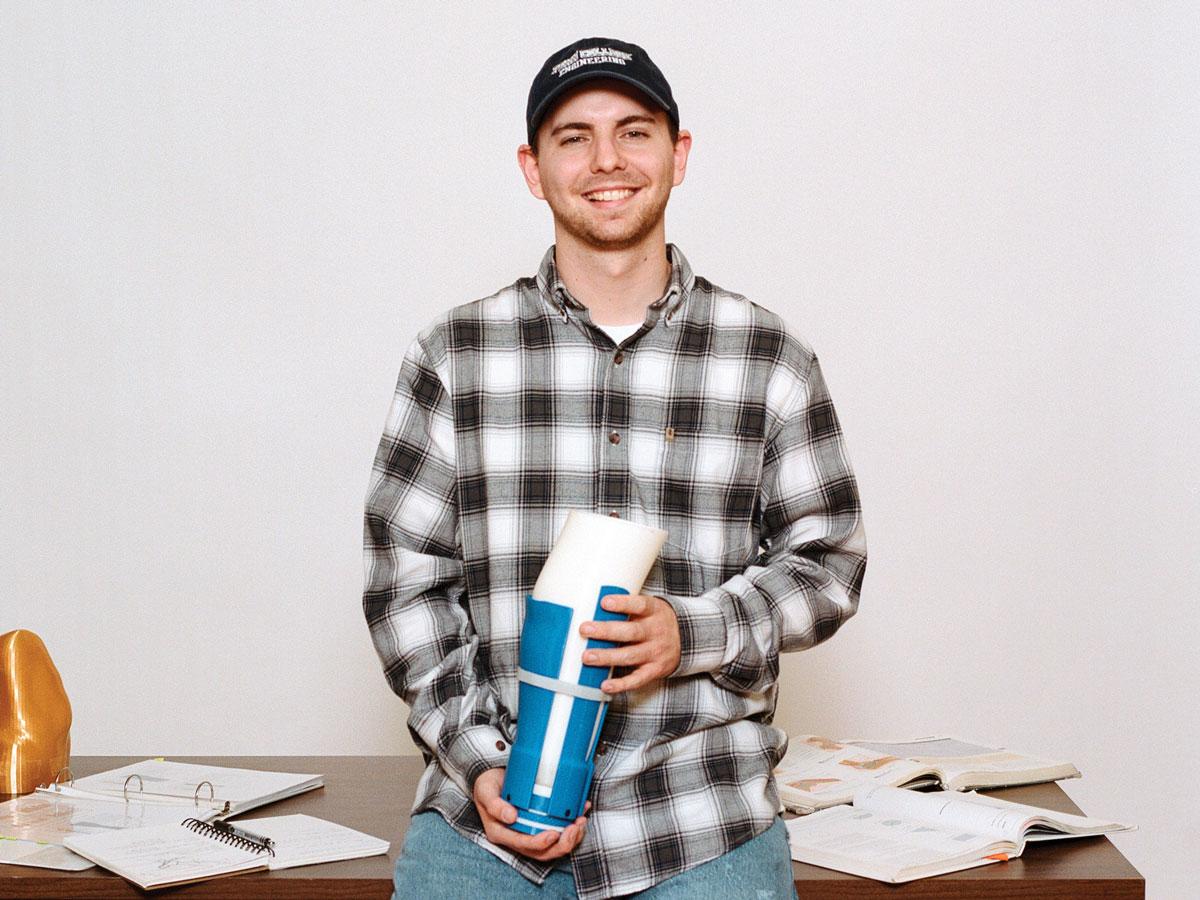
Zachary C. Moore holds a prototype for the “Rose Socket” he designed as a senior project to provide more comfort for those using prosthetic limbs. The 2024 graduate recently received a patent for the invention. Photos by Rudy Fabre.
“Penn College provided an immersive program with a lot of hands-on opportunities at a fraction of the cost of other colleges and universities that offer the same curriculum,” Moore said. “Penn College also has a great reputation for helping its students find a job after graduation and, in most cases, even before that point. Lastly, the smaller program size allowed me the one-on-one time with the professors that I knew I would highly benefit from compared to other bigger colleges. Penn College met all my expectations.”
Miller remembers the highly motivated transfer student entering the engineering design technology major, which today is one of a few such programs accredited by the Engineering Technology Accreditation Commission of ABET.
“Zachary always wanted to do the very best he could with any task assigned to him,” the assistant professor said. “He often performed above and beyond expectations to ensure that the work he submitted was as good as it can be.”
From his first day at Penn College, Moore knew he would have to complete a capstone to graduate. The focus for his eventual study was unclear, but the goal was not.
“I wanted to design something for my capstone that was helpful and creative enough to potentially earn a patent,” he said.
Observations at an ice cream shop and later at a retail store – coupled with insights from industry professionals and prosthetic users – helped inspire and formulate his eventual project.
During the summer prior to his senior year, Moore worked at Double Dips, an old-fashioned ice cream stand in Medina, New York. When taking the trash out one sunny afternoon, he noticed a kindergarten-age girl playing with other children in the small grassy area by the stand.
“She would often stop and fuss with her prosthetic leg/socket. And from that, I decided that coming up with a potential solution to aid in that type of situation would be my capstone project,” he recalled.
Not that it would be easy. The project consumed the spring semester of his senior year. “I went through many different design iterations,” Moore admitted.
Input from engineering design faculty, along with technical advice from Emily Siffrinn – a certified orthotist and prosthetist in Williamsport – proved helpful. Through Penn College connections, Moore also gained the perspective of prosthetic users Diane Matter and James Healey. But it was a random experience at a Walmart that Moore credits for a big breakthrough.
Suffering from daily project fatigue, Moore decided to run some errands to clear his mind. While in the local Walmart, he noticed a worker fluffing roses and other flowers at a Valentine’s Day display.
“From that, a lightbulb went off. I recognized that the way in which a rose opens and closes would be a great base point to design the mechanism for my adjustable socket design,” Moore said.
The spiral appearance of the roses inspired him to create the ratcheting mechanism that opens and closes the prosthetic socket. Moore’s invention uses spiral tracks arranged in a circular pattern, requiring a twisting motion to align the panels to the desired socket opening.
To honor the floral stimulus, Moore called his capstone the “Rose Socket.”
“Developing a practical and cost-effective design was the most challenging aspect,” he said. “Too much complexity or moving parts can lead to higher rates of failure and can also lead to higher costs. I found it most challenging to keep the moving parts to a minimum while meeting the goals I had set.”
Moore’s current goal is to license the patent to a company that will manufacture and market the device to serve both lower and upper amputees. The adjustable panels are designed to be 3D printed from carbon fiber nylon material. The mechanism responsible for expanding and contracting the panels is to be made from a combination of injection-molded plastic and aluminum, cut from a laser or computer-numerical-control machine.
A drawing within Moore’s patent documents depicts his prosthetic socket.
Receiving an “A” on the capstone pleased Moore. Obtaining the patent thrilled him. Witnessing the “Rose Socket” change lives would overwhelm him with joy.
“Oh, it’d be absolutely phenomenal to see it because of the different aspects that I had woven into the project to account for different challenges an amputee may encounter,” said Moore, who is considering a master’s degree in medical device design. “It would be really rewarding.”
“Rewarding” is how he views his time at Penn College – a place that nurtured his inventive spirit and sharpened his technical skills, planting the seeds for a career that is now in full bloom.
“I am very grateful to Penn College for providing me with the opportunity to explore my passions in developing medical devices,” Moore said, “and for providing me with a strong engineering design foundation for all my future endeavors.”
Share your comments
Penn College Magazine welcomes comments that are on topic and civil. Read our full disclaimer.
We love hearing from you