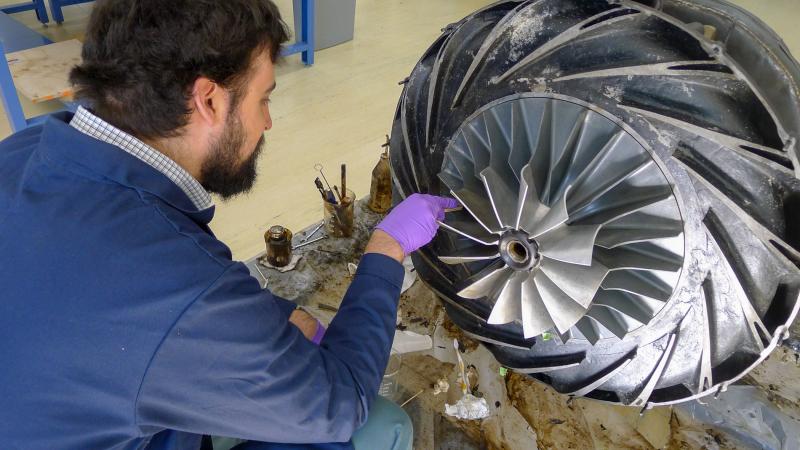
Today’s “object” is a turbocharger that supplied extra air to the engine of an experimental German World War II high-altitude fighter. According to Ravizza’s research, only three such aircraft were built. He’s tasked with stemming the magnesium corrosion.
“Problem-solving is what I enjoy the most,” he said. “Something comes in, and we have to figure it out. It’s like, ‘What the heck is this?’ It’s incredibly fascinating to find out what it is and what its purpose was and deciding how we are going to fix it.”
Growing up in Honesdale, Ravizza loved to fix and build “stuff,” and he collected old locks and keys. It’s safe to assume he was the only kid in his class who amassed handmade European ones from the 16th and 17th centuries, as well as early American locks.
“That was always my kind of thing,” Ravizza said, as if describing a bland baseball card collection.
Three years of high school metal shop convinced him to study machining at a college close to home before enrolling at Penn College, where he earned associate degrees in toolmaking technology and automated manufacturing technology in 2007.
“I liked the instructors, the facilities, access to other programs, a wide spectrum of things,” Ravizza said. “I also liked how you could get an associate degree at Penn College and then go into the bachelor’s program. You could stop halfway if you wanted and return and painlessly fit back in.”
That’s what Ravizza did. He worked as a machinist and toolmaker for about four years to “master the trade” before returning to Penn College and obtaining a bachelor’s degree in manufacturing engineering technology in 2014.
He culminated his Penn College days by building a 1,000-pound forging hammer for his senior project. Powered by an air compressor, the machine includes a 350-pound anvil base and 90-pound hammerhead to form and shape metal.
“Dan is certainly one of our most memorable students,” English said. “Every task he did was completed to the best of his ability. The results were usually terrific. Dan was wise beyond his years. He had the ability to look at a situation and assess what needed done and would plan to achieve his goals.”
Ravizza followed that approach when it came to his career. He wished to combine craftsmanship with history, so he obtained a master’s degree in conservation studies from West Dean College of Arts and Conservation in Chichester, England.


Share your comments
Penn College Magazine welcomes comments that are on topic and civil. Read our full disclaimer.
We love hearing from you