“I was overstressed. … I wasn’t really being given work that truly challenged me,” said Pennsylvania College of Technology faculty member Summer L. Bukeavich. “That’s when I kind of felt things slipping, not only emotionally but physically, as well. I would come into work, and I would be tense right from the get-go.”
A personal experience Bukeavich had early in her career led her to pursue a better understanding of mindfulness in the workplace.
“If we’re not satisfied in our careers, we’re prone to problems – especially with mental health,” said the former marketing professional who is an assistant professor of business administration/management and marketing at Penn College.
“Our physiological response to anxiety is very well-intentioned. It worked well for us long ago, when we saw it like ‘that lion over there.’ We had to run to save our life. … But now we interpret something like a looming deadline as that same type of primitive threat, and so we have that primitive response,” she explained during an interview for “Working Class: Helping & Healing.”
“When we’re in the workplace and when we misinterpret those threats as being really primal, I think we’re prone to have these physiological reactions, which frankly don’t help us be good employees,” she added. “If we’re always coming to work stressed, and if we’re always coming to work with a racing heart and with tense muscles, how are we going to do our best work?”
Bukeavich encourages students to integrate mindfulness and other stress-reduction measures into their daily lives so they can be calmer and more present in their workplaces.
“I ask them to sit for just 30 seconds. I time it, and I say, ‘OK, get a piece of paper and a pen. Every time any thought comes into your head – it can be anything: ‘What am I going to eat for lunch?’ ‘Why are we doing this silly activity?’ – put a check mark on the piece of paper, and then at the end of the 30 seconds, see how many check marks you have.’ That is one of the best ways for a beginner to come to understand the idea of what it means to be present in the moment.”
Being present is especially important in careers focused on helping others heal.
“If you’ve got a patient who’s talking to you about what they’re feeling or what their problems are, instead of relying on whatever schema you might have in your head, mindfulness kind of helps you reach outside of the knowledge that you learned in the past and assess – fully assess – the present moment,” she explained.
Humans naturally seek patterns and look to past experiences to explain present situations, but Bukeavich cautions: “If we let our brain jump in early with the conclusion that we think is true, we might be making some very big mistakes because we’re neglecting to notice what’s actually there.”
She points to a wide variety of research that supports the positive effects of mindfulness in the workplace.
“It can help people retain more information,” she said. “It's been shown to increase job satisfaction, job engagement, creativity, job performance. … It reduces things like emotional exhaustion and stress, even accidents in the workplace, because when you practice paying attention to being in the present moment, you tend to be more cognizant of what's going on around you.”
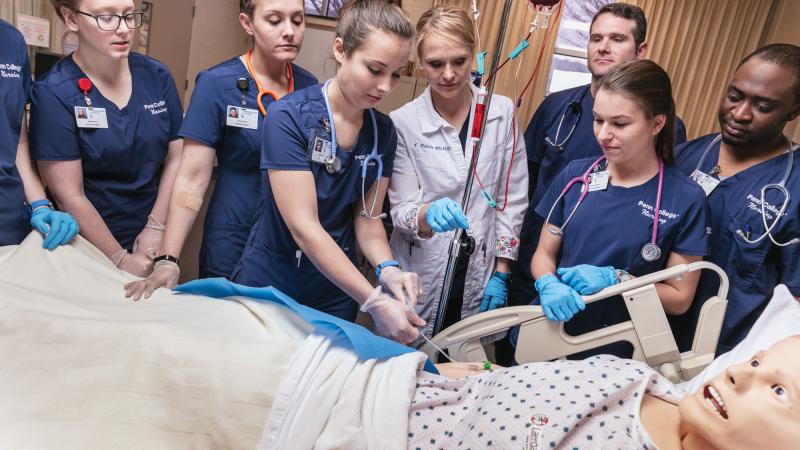
Other Penn College faculty featured in “Working Class: Helping & Healing” spoke about the importance of health care professionals paying attention to their own health and well-being throughout their careers.
“What you do in your 50s determines your 60s. What you do in your 60s determines your 70s. What you do in your 70s determines your 80s. What you do in your 80s determines your 90s. Each decade will prepare you for what you're doing in the following decade,” said Tina M. Evans, associate professor of applied health studies.
She likes to remind students that, to be most effective, good habits should start early.
“That starts in your 20s, having that good foundation of transitioning from high school to college,” Evans said. “And keeping healthy habits, keeping the ability to exercise a couple times a week, and eat correctly, and avoid bad substances or things that we know are damaging to the body, like alcohol and cigarettes or street drugs. Having that confidence to live what you’re saying to patients makes all the difference in the world.”
- Elaine J. Lambert

Share your comments
Penn College Magazine welcomes comments that are on topic and civil. Read our full disclaimer.
We love hearing from you