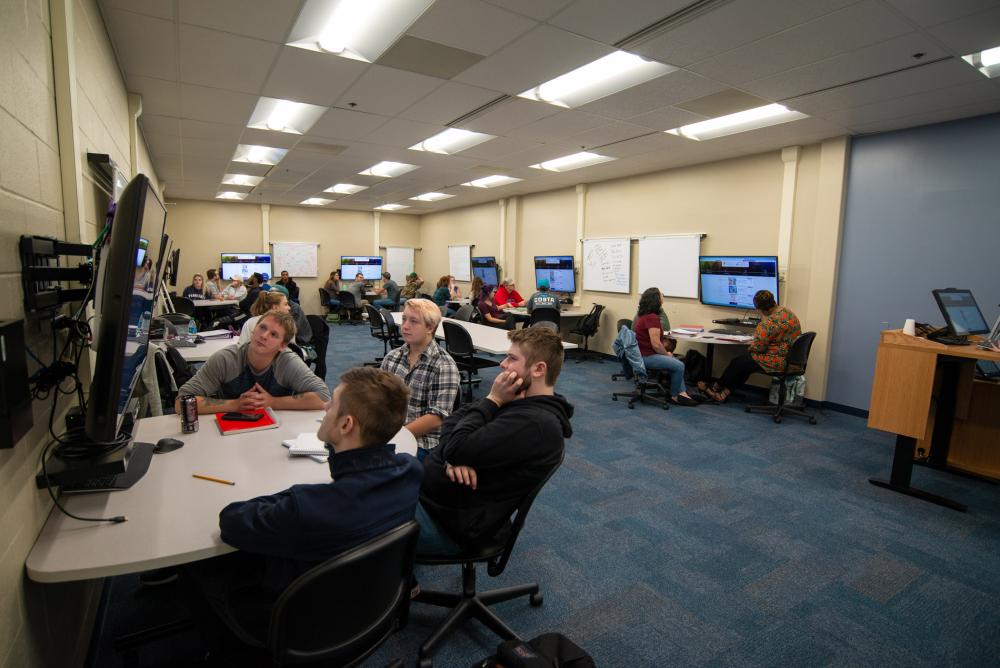
The college’s applied innovation coursework is offered in connection with the Eureka! Ranch and the Innovation Engineering Institute and teaches a scientific approach to inspire the spontaneity of creative thinking, as well as skills in communicating, testing and implementing new products, services and processes.
Appropriate to any field, the concepts are based on the continuous-improvement principles of W. Edwards Deming, who is credited with helping to rebuild Japan’s economy after World War II. Deming taught that in order for companies to remain competitive, they must develop a practice of never-ending innovation to meet customers’ evolving needs and tastes. The concepts were refined into a system by corporate innovator Doug Hall, founder and CEO of the Eureka! Ranch.
“It gives you a new way of thinking when you are dealing with projects,” Tkatch said. “It gives you a new approach. It might not seem like it will work at first, because of the unique way of getting the ideas, but it really brings a lot of different people together, thinking in different ways.
“They were fun classes to go to,” he added. “One of the parts I really liked about the program was there were various students from different backgrounds and different degrees who took these courses, so it was a diverse group. When you’re with students in your degree, you think one way, but when you bring in other students, it brings in different perspectives.”
As the cohort moved through the courses together, they got to know one another – and the faculty, all Black Belt-certified.
“We had a lot of attention from the instructors,” Tkatch said. “It was a refreshing class to go to, because you never felt intimidated, and you felt like your ideas could flow freely.”
Today, his innovation and welding studies are working hand-in-hand for Tkatch and his clients.
“I learned to come up with meaningfully unique ideas,” he said, “so I use that to help customers come up with meaningfully unique ideas to improve their processes. You have to go to market in a unique way, because there’s a lot of competition out there.”
It’s also helping his resume stand out.
“It’s more attractive in the marketplace when you’re competing for a promotion or a new position,” he said. “One of the vice presidents (for Lincoln Electric) has the same Black Belt; it gives you another talking point, another competitive advantage because you have knowledge of a specific topic that others don’t.”
When he runs into other Penn College welding graduates at conventions, it reinforces the value of his “meaningfully unique” degree.
“When you see your classmates out in industry working for big companies, it shows the impact that Penn College has on industry.”