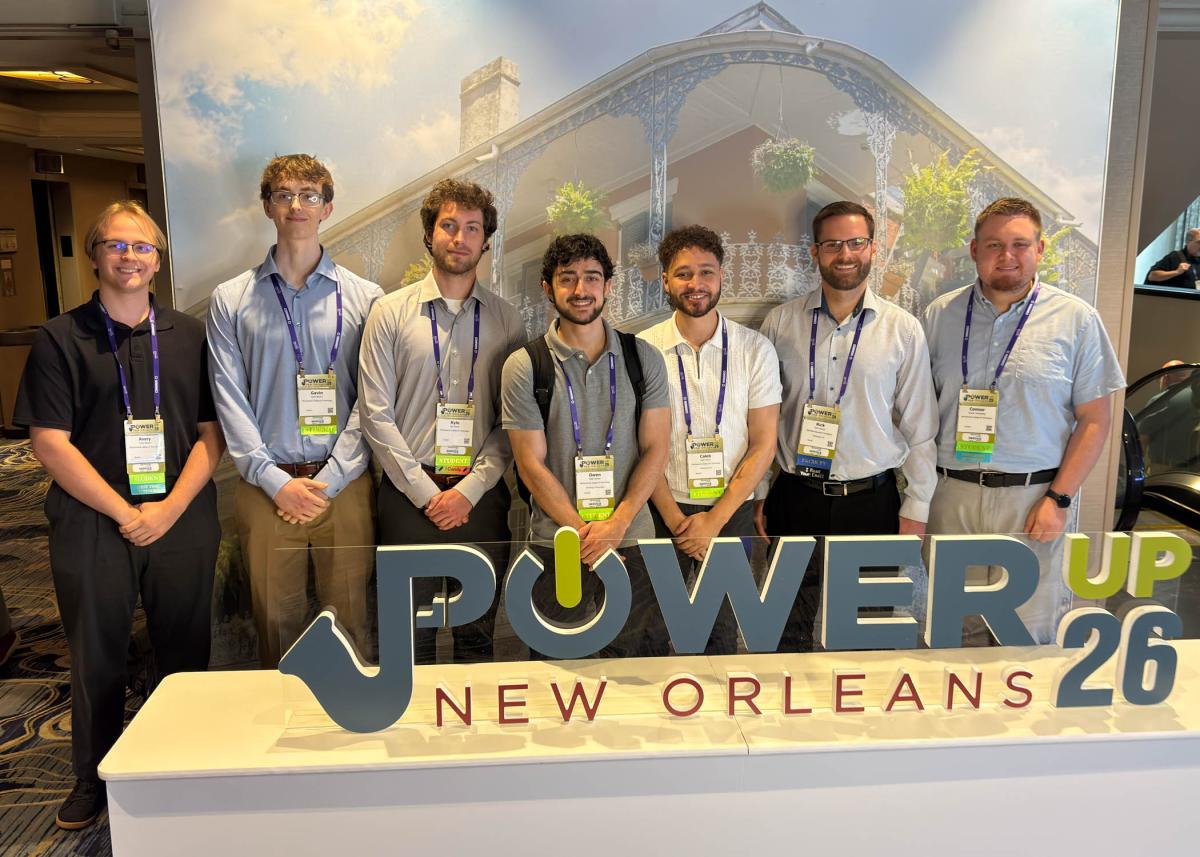
Guided by Rick Crossen, assistant professor of computer information technology, the students spent about two months – mostly outside of class – using IBM i to design and build agentic AI solutions to solve real-world business needs. The reward for their effort was attending POWERUp 2026 in New Orleans. The conference was organized by COMMON, the world’s largest users association for IBM Power Systems.
“The IBM iMPACT Challenge required students to bridge their existing technical skills with new systems integration and incorporation of emerging AI technologies,” Crossen said. “Developing and employing agentic AI solutions is a skill sought after in the IT industry, and this competition offered an opportunity for Penn College students to experiment with these emerging technologies, using enterprise-level tools for a real business problem.”
The three two-person Penn College teams completing the challenge were first place: Gavin L. Bowers (information assurance & cyber security) and Kyle D. Shuler (software development & information management), both of Williamsport; second place: Avery Z. Bowers (information assurance & cyber security), of Tunkhannock, and Connor L. Hackenberg (network administration & engineering technology), of Birdsboro; and third place: Caleb J. Palmer (network administration & engineering technology), of Dillsburg, and Owen M. Sheffer (network administration & engineering technology), of Harrisburg.
“All the students were given virtual computers by the IBM Power Skills Academy so they could test their tools as well as trials for the IBM watsonx AI model,” Crossen said. The IBM Power Skills Academy is an education and workforce-development program focusing on enterprise IT skills related to IBM Power Systems.
For their winning project, called “Sales Insider,” Bowers and Shuler devised an agentic AI solution that uses AI to discover data trends in a sales database and generates graphs to display the trends. The data and graphs can be modified on demand by the user.
Agentic AI systems, such as the ones produced by the Penn College student teams, are more advanced than generative AI tools. Generative AI provides content based on user-generated prompts. AI agents can perform tasks and make decisions.
“You can ask a generative AI model like ChatGPT to find the cheapest flights to Hawaii, and it will give you an answer. Not only can an AI agent find the cheapest tickets, but it could also book the flight, reserve a hotel room and even request room service when you arrive,” Crossen explained. “AI agents are designed with a goal in mind and are given controlled access to systems that allow them to achieve that goal.”
Most of the competition’s judges were from P.C. Richard & Son, a family-owned and -operated chain of appliance and electronics superstores. Steven Wolk, the chief technology officer at P.C. Richard & Son, is an IBM i enthusiast and presented multiple sessions at POWERUp 2026.
During the conference’s opening remarks, Bowers and Shuler were announced as the winners of the IBM iMPACT Challenge. The four-day gathering featured nearly 300 educational sessions, hands-on workshops and networking events.
The IBM Power Skills Academy covered the travel and conference costs for Bowers, Shuler and Crossen. Funds raised through the COMMON Education Foundation paid for the other students to attend.
In addition to POWERUp 2026, the Penn College contingent was invited to the Long Island Systems User Group Horizons 2026 conference in Westbury, New York. Shuler presented “Sales Insider” and Palmer and Sheffer showcased their AI agent, “Richard AI,” at the symposium.
The idea for the IBM iMPACT Challenge arose last fall during Common’s NAViGATE 2025 conference in Pittsburgh that Crossen attended with nine Penn College IT students. At that gathering, Laura Uberhor, senior consultant and owner of Consultech Inc., a technical consulting company, and Linda Alkire, program manager for the IBM Power Skills Academy, asked Crossen to help develop a competition related to agentic AI.
While this year’s challenge was exclusively for Penn College students, Crossen is optimistic that future competitions will involve more schools.
“Penn College paved the way for student competitions with IBM and set the bar very high for future competitors!” he said.
For information on IT programs and other majors offered by Penn College’s School of Engineering Technologies, call 570-327-4520 or visit www.pct.edu/et.
Penn College is a national leader in applied technology education. Visit www.pct.edu, email admissions@pct.edu or call toll-free 800-367-9222.