Discover Non-Destructive Testing

Most people are aware what a nurse or a finance professional does. But, few are aware of an entire subcategory of manufacturing called non-destructive testing.

Discover Non-Destructive Testing

Non-destructive testing plays a role in nearly every industry. Whether you are into bridges, or buildings, or planes, trains, and automobiles, NDT professionals work in those industries to provide an extra layer of defense against manufacturing defects.

Non-destructive testing is checking or inspecting something, without breaking or destroying it, to make sure it will continue to serve its intended purpose. An example would be checking deep inside the metal of a jet’s landing gear to ensure it will not break during landing. Another example is inspecting the welds on a roller coaster to confirm that the ride will be safe.

An NDT professional can be viewed as an “industrial doctor.” They use many of the same methods that medical doctors employ to ensure that whatever they are testing will be safe and not break down while in use. They inspect many different material objects that are used in everyday life.

According to publicly available data, the most common degree for non-destructive testing is an associate’s degree. At Penn College, students can pursue an associate’s degree in NDT. For students interested in welding, the NDT minor is a valuable way to broaden the coursework while becoming more valuable to manufacturing companies in many sectors.

A self-motivated individual who likes challenges and solving them. The ideal individual will also be the type of person who does not like to do the same thing day after day for a career. If you are meticulous and strive for perfection, NDT may be for you.

You will learn to safely evaluate materials and structures for defects using a variety of non-destructive testing methods. Gain an understanding of industrial safety standards in both field and manufacturing settings, as well as how common welding processes relate to the types of defects that can occur. In addition, you’ll develop hands-on skills in multiple NDT techniques, including surface inspection methods, radiographic testing, ultrasonic testing, and advanced phased-array ultrasonics, preparing you to accurately detect flaws and report your findings in professional environments.

Absolutely. Students will receive extensive training in labs for the various types of non-destructive testing and welding they’ll encounter in their careers. This includes multiple welding courses that emphasize the common defects created during welding processes like GMAW and GTAW. 

A student pursuing the Penn College associate's degree in NDT will learn the six most widely used NDT methods in industry:

  • Visual Testing (VT) Inspecting materials and welds visually with hand gauges and instruments to aid the examination.
  • Penetrant Testing (PT) Inspecting materials and welds with the aid of special liquids applied to the surface of the material/weld to determine potential flaws.
  • Magnetic Particle Testing (MT) Inspecting materials and welds by using magnetic fields applied to the surface of the material/weld to determine potential flaws.
  • Eddy Current Testing (ET) Inspecting materials and welds by using the current created by magnetic fields applied to the surface of the material/weld to determine potential flaws.
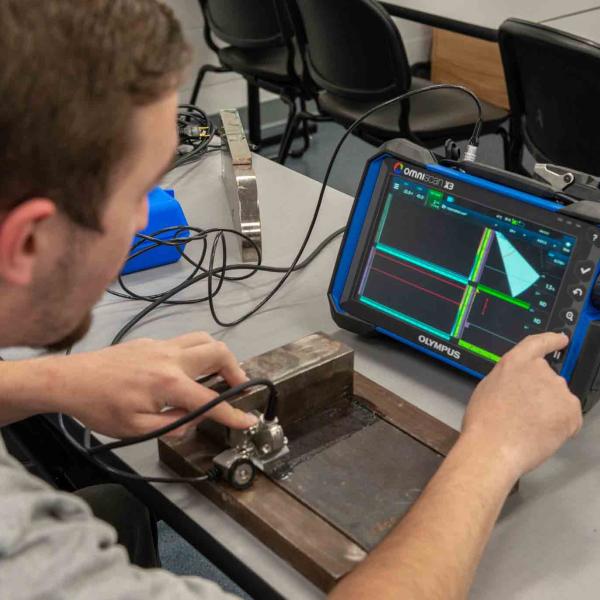
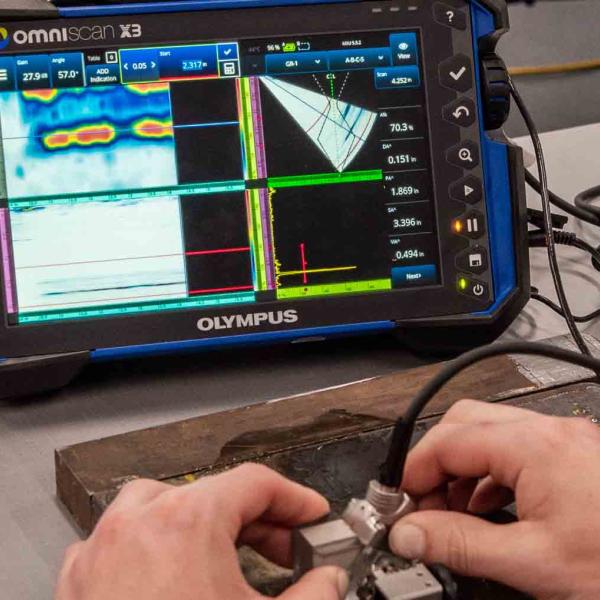
  • Ultrasonic Testing (UT) Inspecting materials and welds with the aid of ultrasonic waves sent into the material/weld to determine if a flaw may be present deep within the part’s thickness.
  • Radiographic Testing (RT) Inspecting materials and welds by sending x-rays into the material/weld to determine if a flaw may be present deep within the part’s thickness.

The NDT student is required to take a welding class, not to become proficient at welding, but to understand the types of flaws a welder encounters. This gives the future NDT professional firsthand knowledge of the many different types of flaws, how they develop, and ways to overcome the issues that arise in industry.

Becoming an NDT professional

Through a combination of welding and weld integrity testing, students leave prepared to land their first job as an inspector or technician. Through ASNT’s progressive certification process, career advancement is defined and achievable. 

With the rapid advancement of technology, non-destructive inspection is more critical than ever. The NDT job market has been called “red hot.” Everything (airplanes, boats, cars, and trains) goes faster. Buildings are higher. Bridges are longer. Pipelines are expanding. And don’t forget about the growing need in aerospace, oil and gas, and manufacturing.

The associate's degree in NDT is a comprehensive study of conventional single-element ultrasonics and phased array ultrasonics. The student will gain detailed knowledge on how different types of ultrasonic waves propagate through materials and the changes that occur during the wave’s journey. The student will acquire extensive hands-on experience in lab sections that will prepare them to correctly interpret a code for ultrasonic inspection, calibrate the ultrasonic instruments, perform the inspection, analyze the data collection, evaluate and pass judgement as to the acceptance of the inspected component, and complete a detailed report on the findings.

The NDT minor provides the basics of the ultrasonic course material used in the associate's degree. However, the minor includes neither the high level of physics relevant to ultrasonics nor the extensive hands-on training with the instruments that the associate's degree students receive.

The value of the Penn College NDT degree

By staying closely connected to industry through career fairs and advisory committees, our students are prepared to contribute to their employers from day one. And be paid for it. 

In short, absolutely. The Penn College program satisfies the classroom training hours required by ASNT, the American Society for Non-Destructive Testing. The real bonus is that the NDT graduate has the high-level knowledge to pass the many tests they will take in industry for their certifications.

The sky is the limit considering what needs inspected: bridges, buildings, ships, aircraft, train systems, elevators, automobiles, pipelines, military equipment, defense missiles, steam/pressure vessels, amusement rides, race cars, and much more.

The NDT curriculum is structured to prepare the Penn College graduate for the skills required to be successful upon graduation, not just the extensive testing knowledge in many methods of NDT. The student will be proficient in math and writing skills pertaining to their career and have self-motivated thinking skills that will make them stand out in today’s career marketplace.