Penn College Workforce Development’s seven polymer workshops drew 76 participants from 15 states, and an eighth workshop in the series is scheduled for Oct. 7-8 at Kiefel Technologies Inc. in Dover, New Hampshire.
Participants learned to select plastic materials that enhance product performance, identify factors that increase process profitability, reduce quality errors through improved process control, and apply effective molding, extrusion and forming techniques.
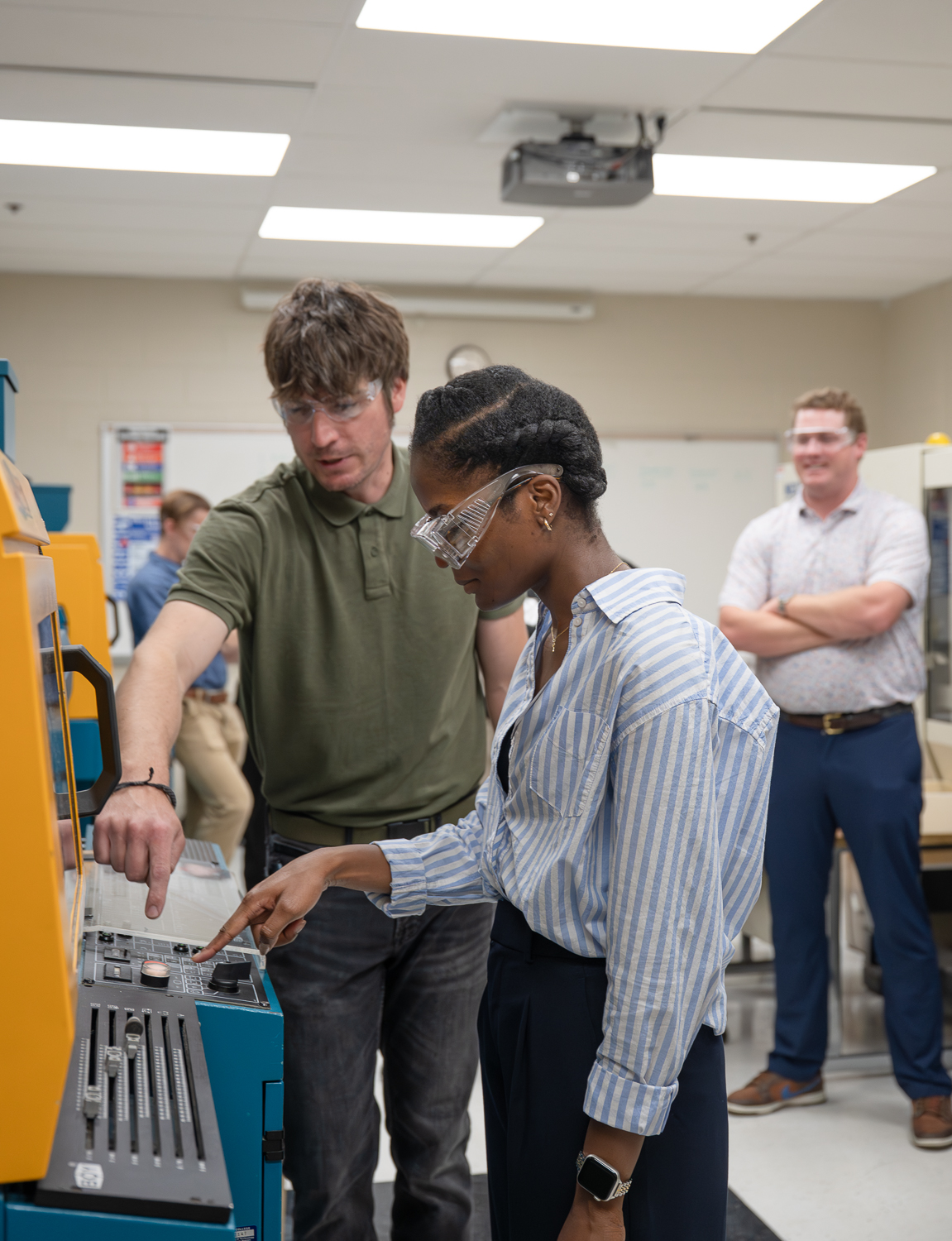
Mark A. Sneidman, instructor of polymers technology, works with a participant of Plastics 101, a three-day workshop offered by Penn College Workforce Development.
The seven workshops were:
- Color Science & Weathering
- Focused on the coloring of plastics and the fundamentals of weathering, including an introduction to color, appearance assessment, the interaction of objects with light, illuminants, the human observer, color-order systems, spectrometers, samples, tristimulus systems, color-difference equations, statistics and industrial color control.
- Plastics 101 Workshop
- Provided foundational knowledge of plastics (polymers), including how they are processed, tested and characterized, as well as the fundamentals of polymer structure and its effects on polymer properties.
- Heavy Gauge Thermoforming Workshop
- Covered the essential elements of thermoforming, from materials to finished products, and explains the forming processes, variables and techniques that processors need to understand.
- Extrusion Seminar & Hands-On Workshop
- Covered the use of extrusion-industry equipment, including a single-screw extruder, twin-screw extruder, blown film line, capillary rheometer, melt indexer and tensile tester.
- Rotational Molding & Advanced Materials Workshop
- Covered material preparation, molding parameters, part strength and performance, dual-layer molding, material properties and moldability, and how process variables affect final part quality.
- Injection Molding Processing Fundamentals Workshop
- Provided an overview of injection molding technology and covered scientific or systematic molding-method setups, operation and process control.
- Extrusion Die Design
- Introduced die-design principles for all major extrusion processes, including sheet, pipe, tubing, blown film, profiles and coextrusion, and covered the application of polymer behavior to die design.
Bill Dructor, an application engineer at Simona America Industries in Archbald, participated in the Heavy Gauge Thermoforming Workshop.
“The workshop was great,” he said. “It covered, possibly, all the subtopics related to thermoforming. I came in not knowing much and leaving with reasonable confidence relating to thermoforming. Far better than all the books and videos I would have had to endure to get this level of knowledge.”
Alyssa Arend, a customer engineer at Syensqo in Alpharetta, Georgia, found the scientific background and hands-on approach presented during the Extrusion Seminar & Hands-On Workshop to be an effective way to learn about the extrusion process.
Michael Craven, a mold setup technician at Rodon Limited Partnership in Hatfield, said the Injection Molding Processing Fundamentals Workshop helped fill gaps in his existing knowledge.
“It was a great course for me with a rough existing base knowledge to expand on and elaborate greatly with any questions,” Craven said. “The instructor has useful insights, anecdotes and tangible examples.”
Upcoming fall workshops, which include breakfast and lunch each day, are:
- Thin Gauge Thermoforming (co-hosted at Kiefel Technologies Inc.): Oct. 7-8
- Color Science & Weathering: Oct. 20-22
- Injection Molding 101: Nov. 6, 13 and 20
For more information or to register, visit www.pct.edu/polymer-workshops.
The Penn College Workforce Development Polymers Lab is a leading resource for education, training and technical support across the plastics industry. Serving manufacturers, resin suppliers, mold builders and equipment providers, the lab offers access to advanced material-testing capabilities, industrial-scale processing equipment and world-class training facilities. In addition to training, the lab provides technical assistance and consulting services to help companies improve operations and innovate. To learn more, call 570-327-4775 or email wdpolymers@pct.edu.
Penn College offers a bachelor’s degree in polymer engineering technology and an associate degree in polymer technology. Both boast 100% overall job placement.
For information about those and other majors in the School of Engineering Technologies, call 570-327-4520.
For information about Penn College, a national leader in applied technology education, email Admissions or call toll-free 800-367-9222.
