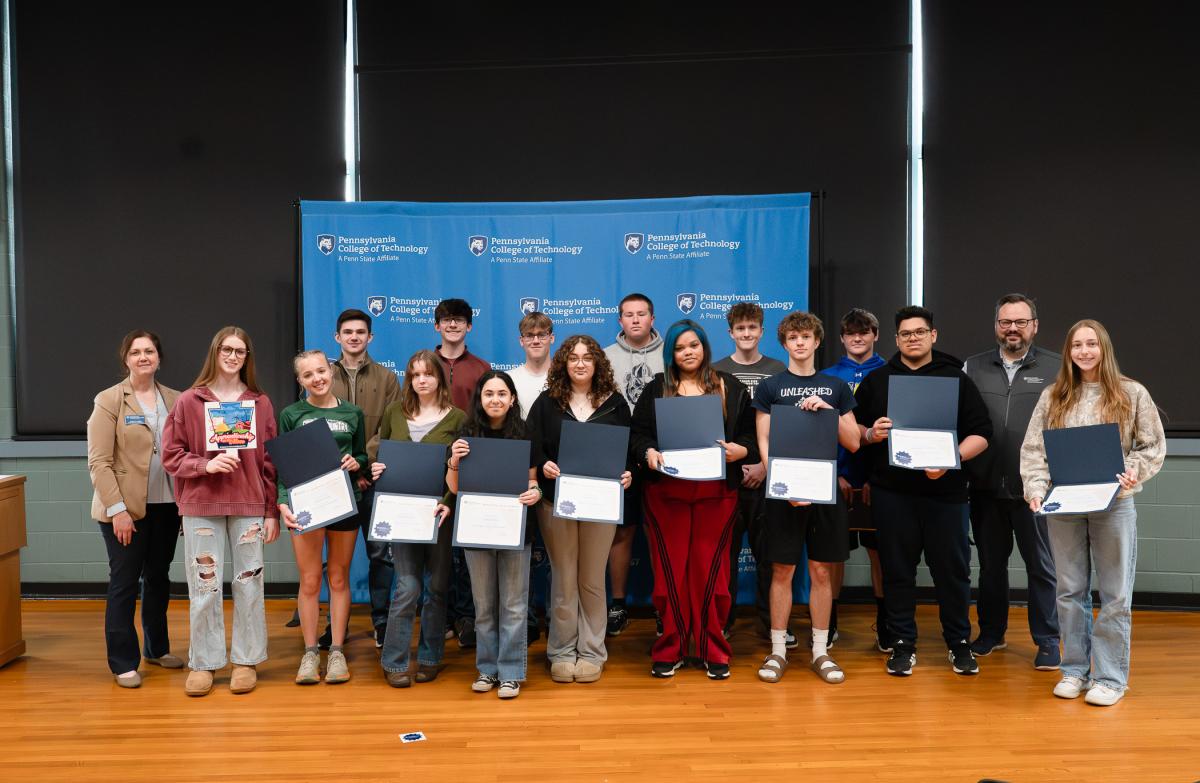
AMP is designed to increase participants’ knowledge of manufacturing concepts and skills and encourage more prospective workers to pursue manufacturing-related careers. The program includes both foundational theory and hands-on experience to prepare participants with entry-level skills for many manufacturing occupations.
“Through AMP, our focus has been on creating a practical, accessible pathway for individuals to explore manufacturing careers and begin building the skills they need to move forward,” said Pamela B. Dincher, executive director of strategic initiatives for Penn College Workforce Development. “More than a training program, AMP is a pre-employment pathway that equips participants with foundational technical skills and essential career awareness. By aligning with employer expectations and registered apprenticeship opportunities, the program helps participants make informed decisions about their next steps, whether that’s entering an apprenticeship, continuing their education or moving directly into employment.”
The college’s strong ties to industry are central to that work, Dincher added.
“Ongoing partnerships ensure programs like AMP stay grounded in what employers are actually looking for, so participants are preparing for real-world opportunities,” she said.
Adam J. Yoder, workforce readiness program manager, said AMP is a true on-ramp to a manufacturing career rather than a one-time training experience. It is formally registered with the Pennsylvania Department of Labor & Industry and directly aligned with four registered apprenticeships in advanced manufacturing offered by Penn College: Computer Numerical Control Operator, Industrial Manufacturing Technician, Mechatronics Technician and Plastics Process Technician. The earn-while-you-learn pathway can lead to 39 tuition-free credits through the college’s associate degree program in apprenticeship technology.
“Participants come out with real, employer-recognized credentials: the Certified Manufacturing Associate from the Society of Manufacturing Engineers, a Penn College certificate of completion and a Pennsylvania Department of Labor & Industry recognition credential,” he said. “Each gives employers a clear, standardized picture of what a completer knows and can do.”
The Pennsylvania Apprenticeship and Training Office recently presented its Outstanding Registered Pre-Apprenticeship Sponsor Award to Penn College Workforce Development, recognizing the college as the longest-running pre-apprenticeship program and honoring its implementation of the AMP at the Lycoming County Pre-Release Center under a Bureau of Justice Assistance Prison-to-College grant, which was awarded through the Second Chance Act. The goal of the grant is to connect justice-impacted individuals with college education and reentry support.
The award is presented to a registered pre-apprenticeship program sponsor that is deemed an “integral part of the apprenticeship ecosystem and valued in assisting pre-apprentices achieve success.”
Being a sponsor for apprenticeship or pre-apprenticeship means that the college takes full responsibility for program creation and registration, ensuring that all participants receive the training and industry exposure required under the program registration, and manages all compliance and reporting at the state and federal levels.
“This award reflects the role we’ve played as a steady, engaged partner in Pennsylvania’s apprenticeship ecosystem,” Dincher said. “The recognition, along with the success of our recently graduated high school students, demonstrates the value of AMP as a tool for career exploration. There is a clear commitment to reaching individuals who may not otherwise have access to these pathways. By removing barriers and creating supportive entry points, AMP helps broaden participation and expand who can benefit from the apprenticeship system.”
The program, Yoder added, is built for accessibility and meets students where they are geographically and academically.
“Delivered regionally across Pennsylvania with transportable lab supplies and sessions scheduled close to students, it removes barriers that would otherwise keep rural and underserved populations from ever engaging with manufacturing careers,” he said. “Year over year, AMP has shown that when you remove the barriers, students rise to the opportunity. That momentum is what we’re building on next, growing this program’s reach and strengthening the bridge between the classroom and the shop floor.”
This initiative is funded by the U.S. Department of Labor and is subject to applicable nondiscrimination and compliance requirements.
To learn more about Penn College Workforce Development, visit www.pct.edu/wd.