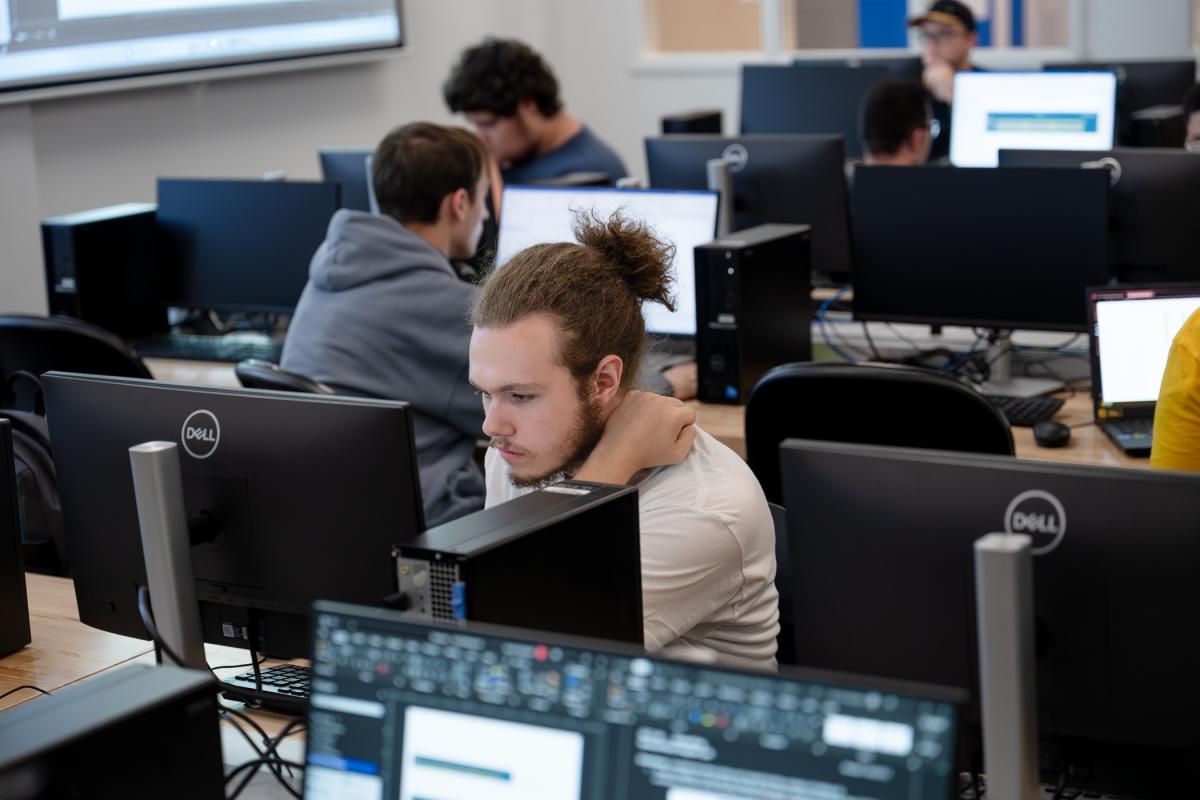
As a national leader in applied technology education, Pennsylvania College of Technology is built for a global economy driven by artificial intelligence. The addition of academic minors devoted to AI reflects that reality.
Beginning in the 2026-27 academic year, bachelor’s degree and combined bachelor’s/master’s degree students can pursue two AI minors: artificial intelligence in industry & society and artificial intelligence foundations & applications. Both minors cover core AI principles but from different perspectives. Artificial intelligence in industry & society is grounded in theoretical and societal applications of AI, while artificial intelligence foundations & applications emphasizes more technically intensive coursework that focuses on algorithms and creation of software/tools.
“Penn College students don’t just have the desire to get a job in their chosen field. They set out to make an impact and become industry leaders. With this goal in mind, they understand the need for the knowledge provided by these minors and just how much it may play a role in their future success,” said Rick Crossen, assistant professor of computer information technology.
Crossen and Alicia L. McNett, assistant professor and co-department head of computer information technology, spearheaded the effort to develop the minors.
Although the AI minors are new, dozens of the college’s well-established hands-on, STEM-related majors directly align with the AI economy. Students across campus are being prepared to build, maintain, integrate and optimize the systems that power AI, which according to PricewaterhouseCoopers could contribute up to $15.7 trillion to the global economy by 2030.
Academic programs that fall under automation and robotics, construction and the built environment, energy, manufacturing and fabrication, information technology, and several others produce graduates who contribute to all aspects of AI. Those facets range from data centers that form the infrastructure of the digital world to power systems that meet energy demands and industrial automation that enables intelligent systems.
Penn College Workforce Development supports the growing AI economy through its apprenticeship programs in robotics and automation, industrial maintenance, and mechatronics, as well as its commercial facilities training initiative.
For the two AI minors, a common thread is a new course – Introduction to Artificial Intelligence. The class covers fundamental AI concepts and applications to equip students with the critical thinking skills required to engage with AI technologies responsibly and effectively.
A second new course, AI in Business & Society, examines the myriad ways current AI tools are transforming the modern workplace. The class is specific to the 18-credit artificial intelligence in industry & society minor.
“The artificial intelligence in industry & society minor is distinct because it allows students from many different majors to understand how AI technology can be effectively incorporated in their future profession,” Crossen said. “By having a solid foundation of technical theory and broad understanding of usability, this minor encourages them to use their own creativity to implement AI tools in their future career in potentially new ways.”
The minor also will provide students with several ethical and strategic frameworks so, as graduates, they can help guide conversations and policies regarding AI use in their respective industries.
A third new class, Deep Learning, is required for the artificial intelligence foundations & applications minor. A subset of machine learning – technology that helps computers learn from data to make decisions – deep learning is responsible for many advances in technology, such as computer vision and natural language processing. Deep learning is considered a fundamental skill for those studying AI and data science.
The hands-on nature of the course is emblematic of the 21-credit artificial intelligence foundations & applications minor, which provides practical experience with industry standard AI tools and libraries. Students completing the minor will be prepared to contribute directly to the creation of AI-driven solutions or to pursue graduate studies in the AI field.
“The artificial intelligence foundations & applications minor is designed for those interested in math, algorithms and the technologies behind how AI works. The intent of this minor is not to just look at how and why we leverage AI tools but teach students how these solutions work,” McNett said. “The curriculum takes students from the simplest AI models to the complex deep learning models used by many AI solutions today, all with the hands-on experience that is at the heart of a Penn College education.”
“Our AI committee, comprising faculty and staff, has been working to not only integrate AI literacy and responsible use in the student experience but also to help create hands-on learning experiences that empower students to confidently apply AI in real-world settings,” said Andrea M. Campbell, assistant dean of curriculum & instruction. “By leading the charge in creating these minors, Rick and Alicia have built meaningful pathways for our students to develop high-demand AI skills, strengthening our commitment to prepare industry-ready graduates.”
For information on the minors and AI-related majors offered by Penn College’s School of Engineering Technologies, call 570-327-4520 or visit www.pct.edu/et.
Penn College is a national leader in applied technology education. Visit www.pct.edu, email admissions@pct.edu or call toll-free 800-367-9222.