She sites studies that show time in the outdoors opens the senses and makes for better brain function.
Ideas for the space – in the courtyard bounded by the Hager Lifelong Education Center and Carl Building Technologies Center – came from the center’s teaching staff.
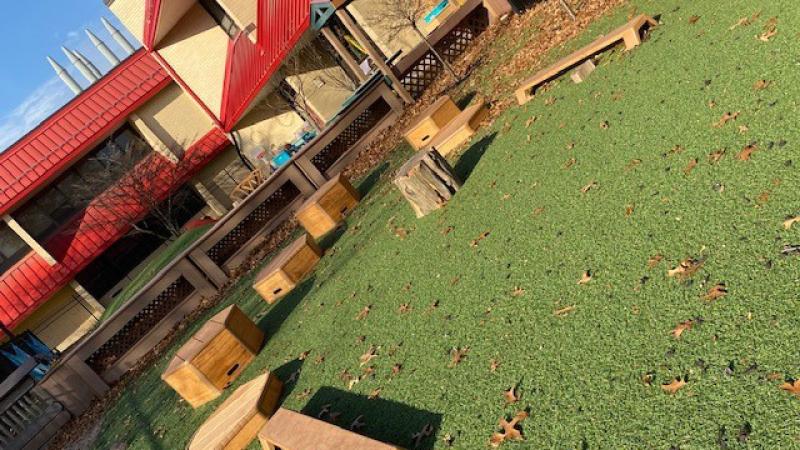
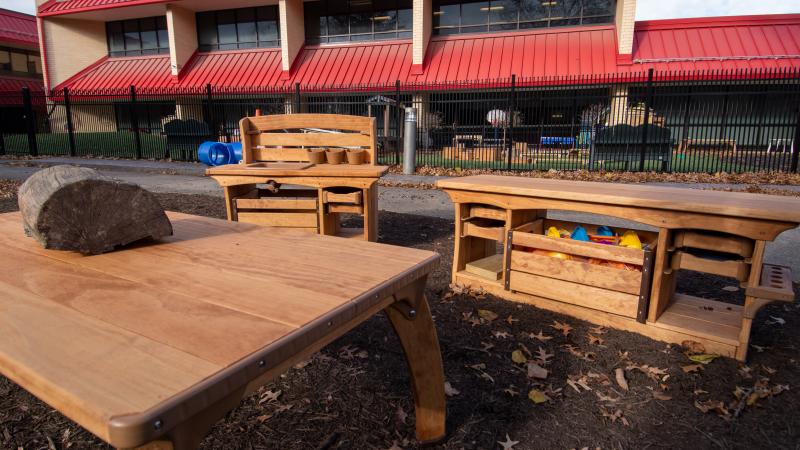
The centerpiece of the Nature Space is a water trough – designed and built by Chad L. Karstetter, horticulturalist/motor pool lead person – that can be used for sensory play with water or mud, courtesy of a “dirt box” nearby that is bordered by child-size benches and can be used for digging, mud-pie making, playing with toy construction vehicles, or any way a child imagines.
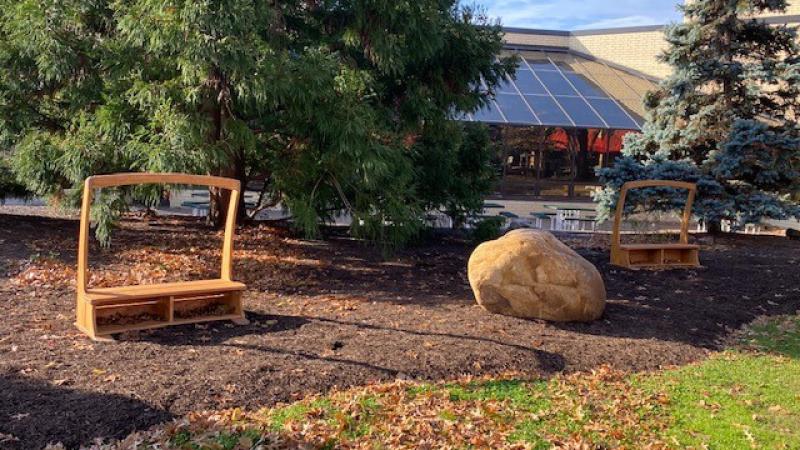
Added boulders in the courtyard (donated by Wayne Township Landfill) provide a climbing surface – and potentially a blank canvas for artwork or messages, much like “The Rock,” a 26-ton boulder that serves as a message board for student organizations near the Bush Campus Center.
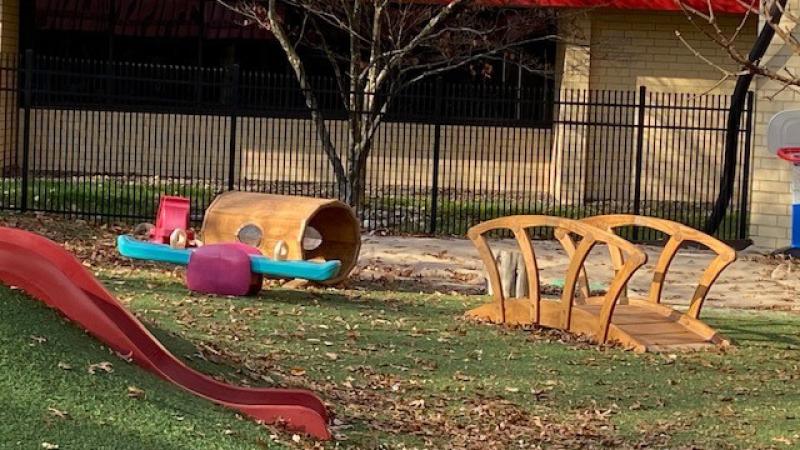
Also part of the expanded landscape are purchased wood toys and props – from tunnels and bridges to promote motor skill development, to ramps for balls or cars that foster outdoor STEM learning, and toy kitchens for imaginative play.
“The children can use things that aren’t necessarily coming from anywhere but the earth,” Reichert said. “That’s my goal for these guys: process instead of product.”
Robert Dunham, who retired from Penn State as senior vice president and dean of the Commonwealth Education System, served as chairman of the Penn College Board of Directors from 1997 to 2012. Maureen Dunham is a retired elementary school teacher, having taught for 28 years. She helped to found and administer the Friendship Tutoring Program for elementary school students.