Penn College News

Collaboration benefits Penn College automation students

Tuesday, February 10, 2026

photos by Alexandra Butler, photographer/photo editor

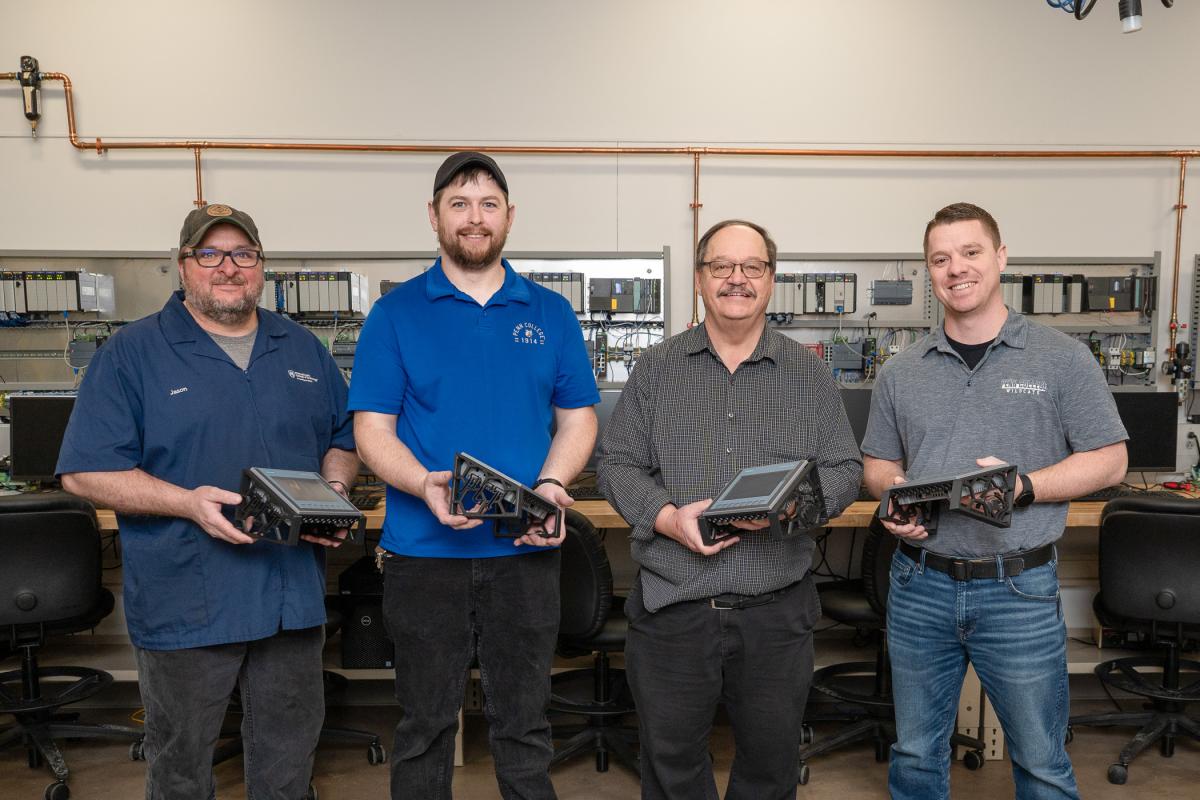
Four Penn College employees hold frames for human-machine interfaces.

The Pennsylvania College of Technology team responsible for designing and manufacturing plastic frames to hold Siemens human machine interfaces display their creations in the college’s automation and robotics lab. From left: Jason A. Yorks, maintenance mechanic/millwright specialist; Bryan Schaefer, instructor of CNC machining & automation; Randall L. Moser, assistant professor of electronics & computer engineering technology; and Luke J. Davies, assistant professor of CNC machining & automation. The 3D-printed frames – in the shape of a rectangular trapezoid – position the HMIs at a 45-degree angle and feature Penn College branding.

A creative collaboration between Pennsylvania College of Technology faculty and staff has resulted in an ergonomically friendly addition to the institution’s automation and robotics lab: customized frames for Siemens human machine interfaces.

The 3D-printed plastic frames with Penn College branding position the HMIs at a 45-degree angle. The HMIs are used with Siemens programmable logic controllers in the Advanced Automation Software class. The lab-intensive course is a requirement for students seeking a bachelor’s degree in automation engineering technology: mechatronics or automation engineering technology: robotics & automation.

Considered the heart of automation, PLCs are robust computers that control industrial equipment such as conveyor belts, robotic cells and HVAC systems. An HMI connects the operator to a PLC via a touchscreen, allowing for monitoring and inputting instructions for the PLC.

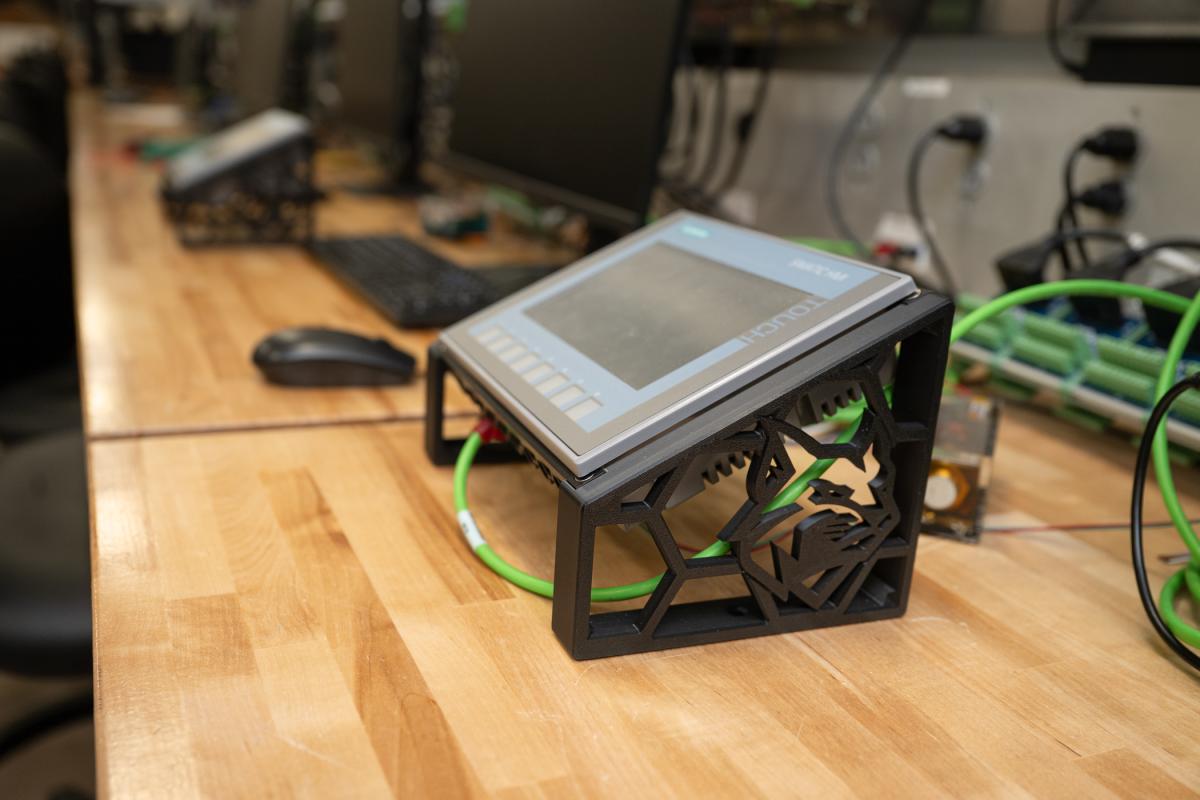
A human-machine interface sits in a right-trapezoid-shaped frame on a desktop.

Each angled frame secures an HMI and positions it in the user’s line of sight.

Without the frames for the Penn College lab, the Siemens HMIs would be unprotected and sit flat on the bench at each PLC station. With the angled frames, the HMIs are secure and positioned in the user’s line of sight.

“The frames are great because you can watch your program for the PLC run on the computer screen and can easily use the touchscreen on the HMI to see how it’s affecting the code,” said Randall L. Moser, assistant professor of electronics & computer engineering technology.

Moser recognized the need for HMI frames and sought the assistance of Howard W. Troup, assistant professor/co-department head of automated manufacturing & machining. Troup produced a protype made of aluminum before the project was turned over last fall to Jason A. Yorks, maintenance mechanic/millwright specialist.
                                                                       
Based on the prototype, Yorks planned to weld pieces of aluminum together to make the requested 20 frames. His approach changed after speaking with Luke J. Davies, assistant professor of CNC machining & automation.

“That would be a lot of work to fabricate the frames out of aluminum, bending at the right angles and welding all that aluminum together. Plus, the aluminum would warp,” Davies explained. “I suggested 3D printing them, and it snowballed from there.”

Davies and Yorks used Autodesk Inventor, a 3D modeling software program, between classes and other work assignments to create the design for the frames in the shape of a rectangular trapezoid, roughly 6 inches long and 5.5 inches tall.

“It was a lot of fun going through the design iterations with Jason,” Davies said. “There was a lot of texting back and forth with photos and ideas for the next revision. The hardest part was getting the initial design – fit and function – nailed down. Then it was just down to tweaking the form with some Penn College branding.”

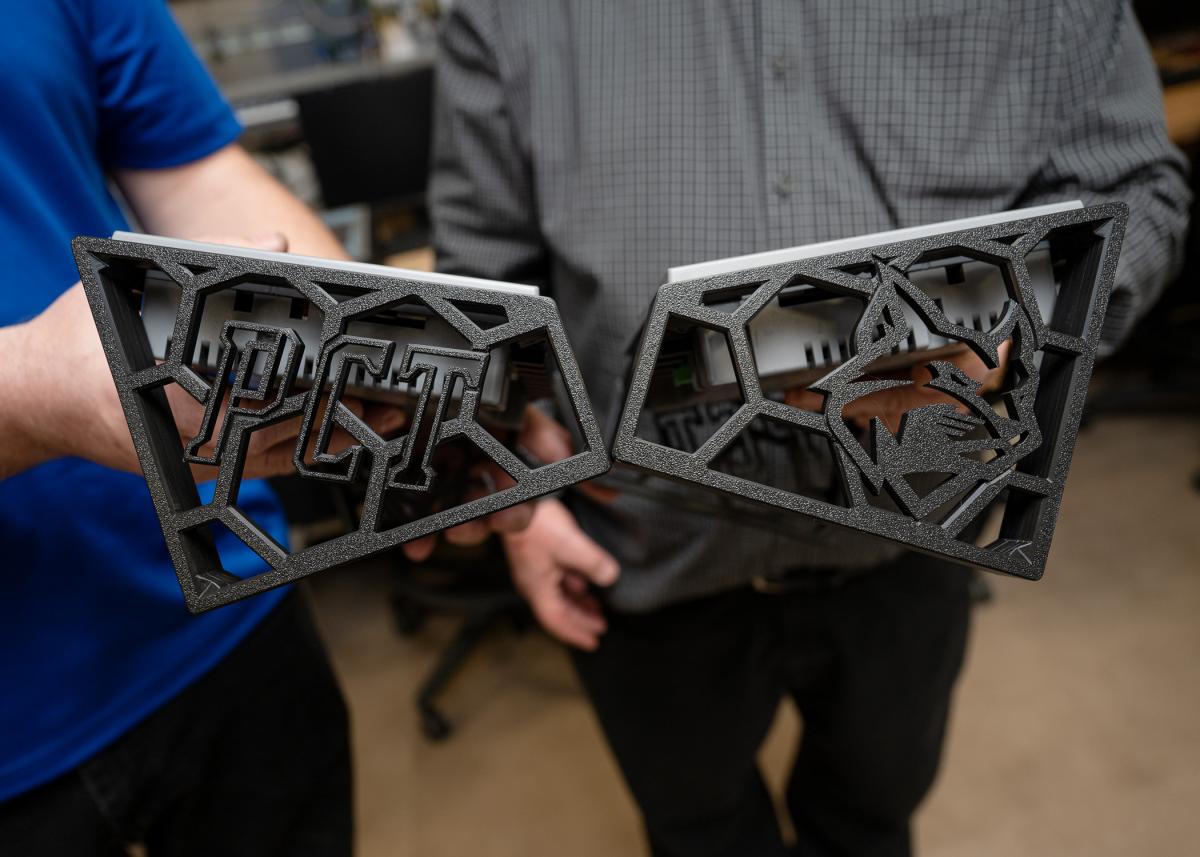
Those tweaks included adding hexagon blocks and Penn College branding to the elevated sides of the black frames. One end panel features the letters “PCT,” and the other includes the school’s Wildcat head logo. Following some testing, the duo set the thickness of the hexagon pattern, “PCT” letters and logo at a quarter inch and the outer perimeter at 1 inch.

Close-up of hands holding right-trapezoid-shaped human machine interface frames. One shows the left side, with large "PCT" letters, and the other shows the right side of the frame, with the college's Wildcat logo.

The sides of the frames promote school spirit with the letters “PCT” and the Wildcat head logo.

Davies, Yorks and CNC machining & automation faculty colleague Bryan Schaefer 3D-printed the four parts for each frame: two end panels and two crossbars. They planned to manually glue the parts together, but Schaefer devised a better method – employing a hot iron press to melt brass-threaded inserts into the plastic so the crossbars could be securely attached to the two ends.

All the parts were printed and fastened within a week, costing less than $250.

“The thing with rapid prototyping is that we can be really aggressive with our designs and ideas and try them with much less expense to the process and timeline, and that’s how innovation happens,” Davies said. “It’s cheap. It’s fast.”

And in this case, the process resulted in the perfect solution.

“It’s great. I am so happy and impressed with the details they went with, including ‘PCT’ and the Wildcat on the sides,” Moser said. “We have a lot of vendors come through our lab, so it’s nice for them to see some of the capabilities that Penn College has.”

A Penn College Corporate Tomorrow Maker, Siemens is a leading technology company focused on industry, infrastructure, mobility and health care. Siemens is a member of the Visionary Society (100,000-$499,999) on the college’s Donor Wall.

For information about Penn College’s automation degrees and other majors offered by the School of Engineering Technologies, call 570-327-4520 or visit www.pct.edu/et.

Penn College is a national leader in applied technology education. Visit www.pct.edu, email admissions@pct.edu or call toll-free 800-367-9222.