Feddersen began his community college career as one of the founding leaders of Bucks County Community College, in southeastern Pennsylvania, when it was launched in 1965. He was hired as the director of admissions and records and became assistant to the president. Enrollment at the new college grew from 700 students the year it opened to 6,000 seven years later, when Feddersen left.
From Bucks, where he gained experience developing resources and overseeing construction projects, he became CEO of Iowa Western University’s Clarinda campus.
Shortly after, he became one of 350 applicants for the president’s position at WACC.
Feddersen was aware of WACC. Built on the foundation of Williamsport Technical Institute, the college was well-known for its unique hands-on programs and, with 20 sponsoring school districts in 10 counties, for serving the largest region of any community college in Pennsylvania.
“These were very attractive features for someone coming in, knowing that they already had this strength, and how can you take a college – maybe it’s got some problems – but take them on to the next step of their evolution,” he recalled.
He met a variety of challenges.
He was tasked with reuniting a campus that was dealing with hard feelings after a contentious faculty strike six months before his arrival. Many of the facilities used by the college were former industrial buildings in need of repair or replacement, and the college, like many others across the country, faced financial difficulties.
Feddersen moved quickly. He reorganized the college’s administrative structure, set up committees to rewrite the college’s mission statement and develop a 10-year long-range plan, and cut $200,000 from the 1974-75 budget.
“I had a vision, but I also knew that I needed to develop a shared vision for the college – that it couldn’t be just my vision,” he recalled.
“I knew the No. 1 job was to rebuild trust across campus – because without that trust, you can’t do anything. So forget about the facility problems and forget about all the other things we want to do.”
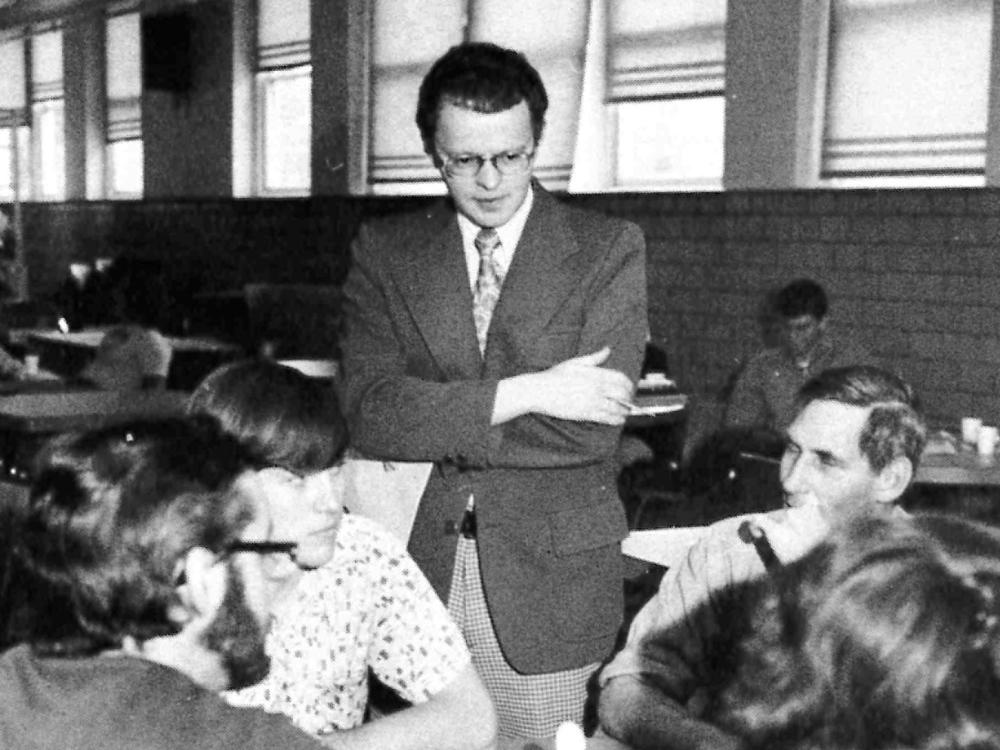
He appointed an ombudsman, Tom McNally, to hear grievances. He named mathematics faculty member Bob Bowers as assistant to the president for employee relations. He began the “President’s Coffee House,” visiting the cafeteria for an hour each week to hear about whatever students wanted to share with him.
He encouraged a forward-thinking attitude, renaming a newsletter “New Day News.”
He also initiated facility upgrades – first in the George S. Klump Academic Center. For nearly 60 years, the building had been home to Williamsport Area High School, which moved to a new location in 1971-72.
The building was structurally sound but needed renovations and repairs. In the summer of 1974, students were hired to do much of the labor.
“We had students from all programs do that work,” Feddersen said. “If you could hold a paintbrush, you could participate. … We had contractors, too, but we basically didn’t have a lot of money, but we had a lot of enthusiasm.”
At the time Feddersen left WACC, construction had begun on three new buildings – the Learning Resources Center (now part of the Henry G. Hager Lifelong Education Center) which moved the college library from an off-site building to a central on-campus location, the Lycoming Engines Metal Trades Center and the Kenneth E. Carl Building Technologies Center.
Among other developments during Feddersen’s tenure was the implementation of developmental education, using a Title III grant, to help ensure students’ success. Much like today’s placement testing process, the college began assessing students’ math, reading and writing skills and placing them in appropriate classes to develop those skills if needed.
“If you don’t assess students and place them into the courses in which they’re prepared to succeed, many will fail,” Feddersen said. “I’ve heard the expression: ‘Students have the right to fail.’ And I say no, they have the right to succeed, and our job is to make them successful.




Share your comments
Penn College Magazine welcomes comments that are on topic and civil. Read our full disclaimer.
We love hearing from you