Penn College Magazine Fall 2025, Volume 34, Number 2
by Thomas Speicher
Writer/Video Producer
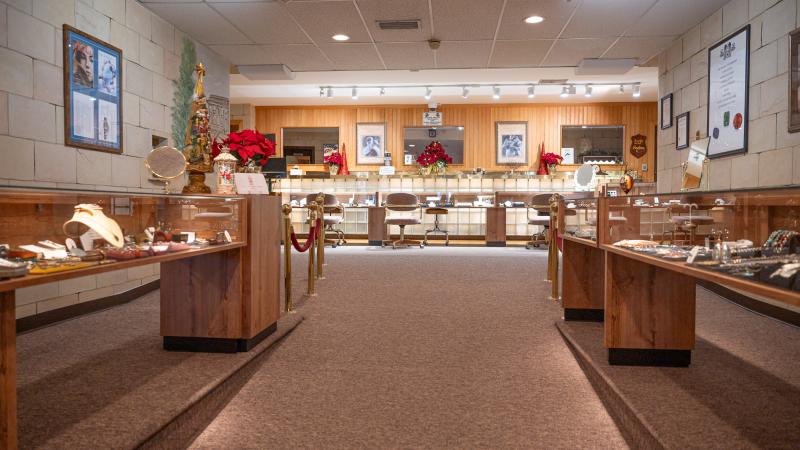
TUCKED AMONG THE QUAINT SHOPS and businesses that give Montoursville its distinctive small-town charm, a nondescript brick building, opened as a movie house in 1947, still hints at its origins as the Laura Theater that served the region for decades.
A concrete slab where the ticket booth sat bears the theater’s name. Tall, art deco-style doors that separated real life from Hollywood make-believe still swing open. Interior glass blocks that added to the ambience of a night out continue to twinkle. Parallel red velvet ropes attached to stanchions in the entrance-way wink at the past.
The building’s legacy is appropriate, considering the owner and occupant for the past 40-or-so years has lived a life worthy of a screenplay. His accomplishments and adventures are rooted in his time as a student at Pennsylvania College of Technology predecessor Williamsport Technical Institute.
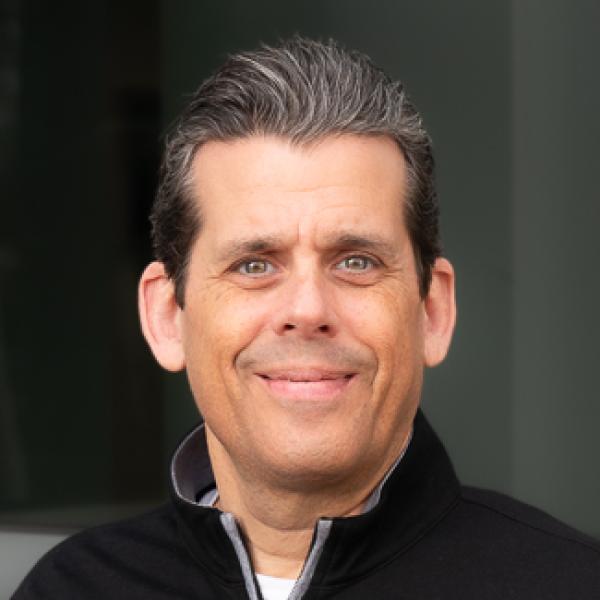
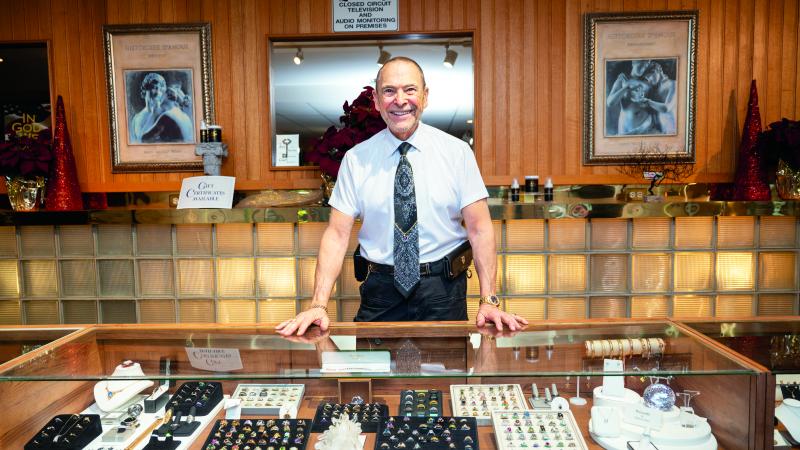
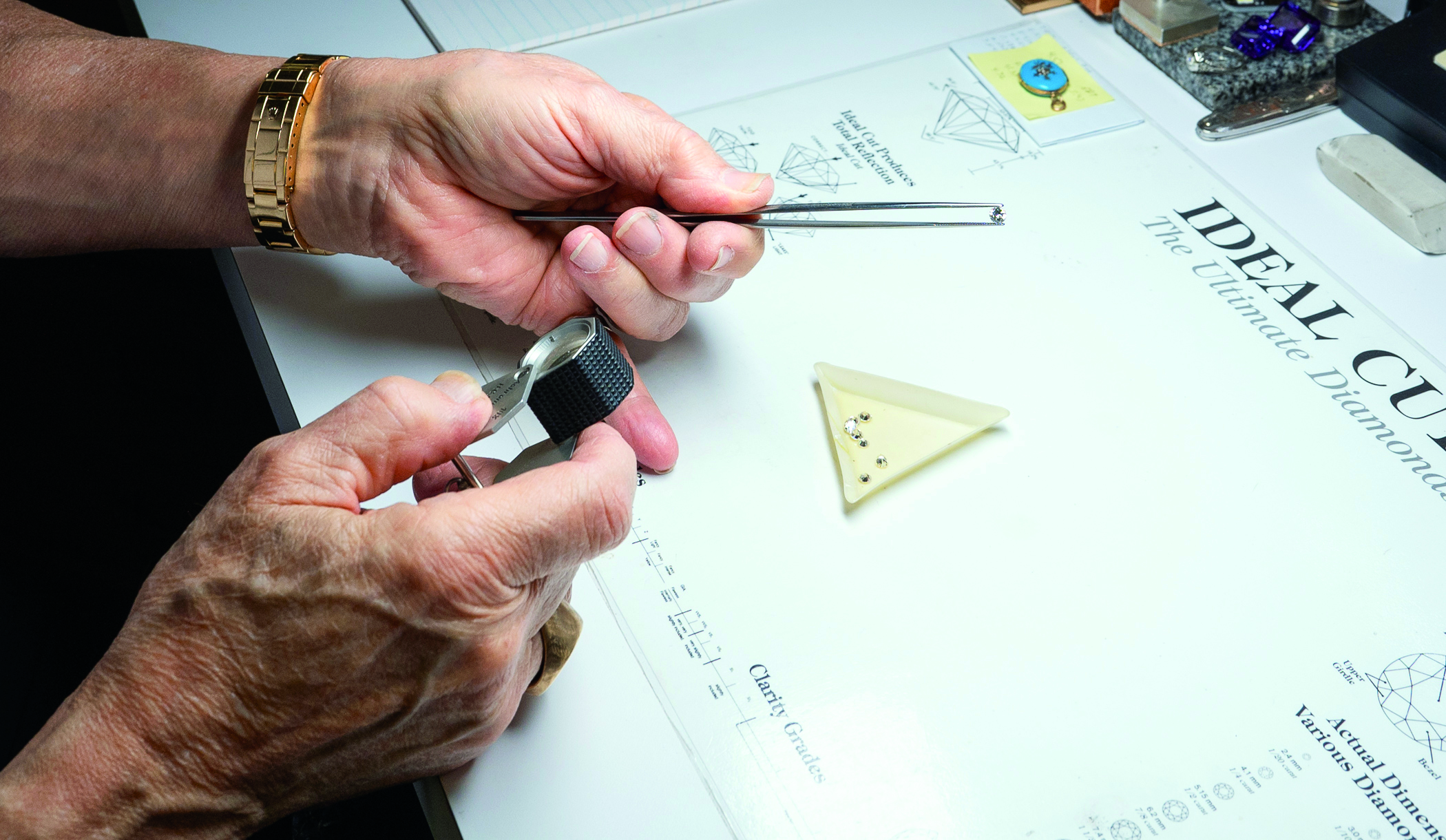
Gary L. Smith is the proprietor of Smith’s Ltd., home to both Smith’s Jewelers and the PA Gem Lab. The front portion of the building is dedicated to ample display cases showcasing unique pieces of fine jewelry crafted by Smith or offered on consignment. The store also specializes in the repair and restoration of antique and estate jewelry. Situated behind, through a maze of rooms, is the PA Gem Lab, a forensic appraisal area where Smith serves clients from throughout the world.
“I like to say the whole basis of this place started at WTI,” Smith said.
A 1963 WTI electronics graduate, Smith is both a master goldsmith and gemologist, with certifications that consume an entire wall of the jewelry store. His favorite one is master gemologist appraiser from the American Society of Appraisers. “There are fewer than 50 or so of us in the world who maintain that designation,” Smith said with obvious pride.
The fit and vibrant 81-year-old rises at 4:30 most mornings and works about 60 hours a week while allotting time for family (three daughters, nine grandchildren and three great-grandchildren), lifting weights at the YMCA and co-pastoring a church with Helen, his beloved wife of nearly 60 years. “Retirement is not an option,” he said.
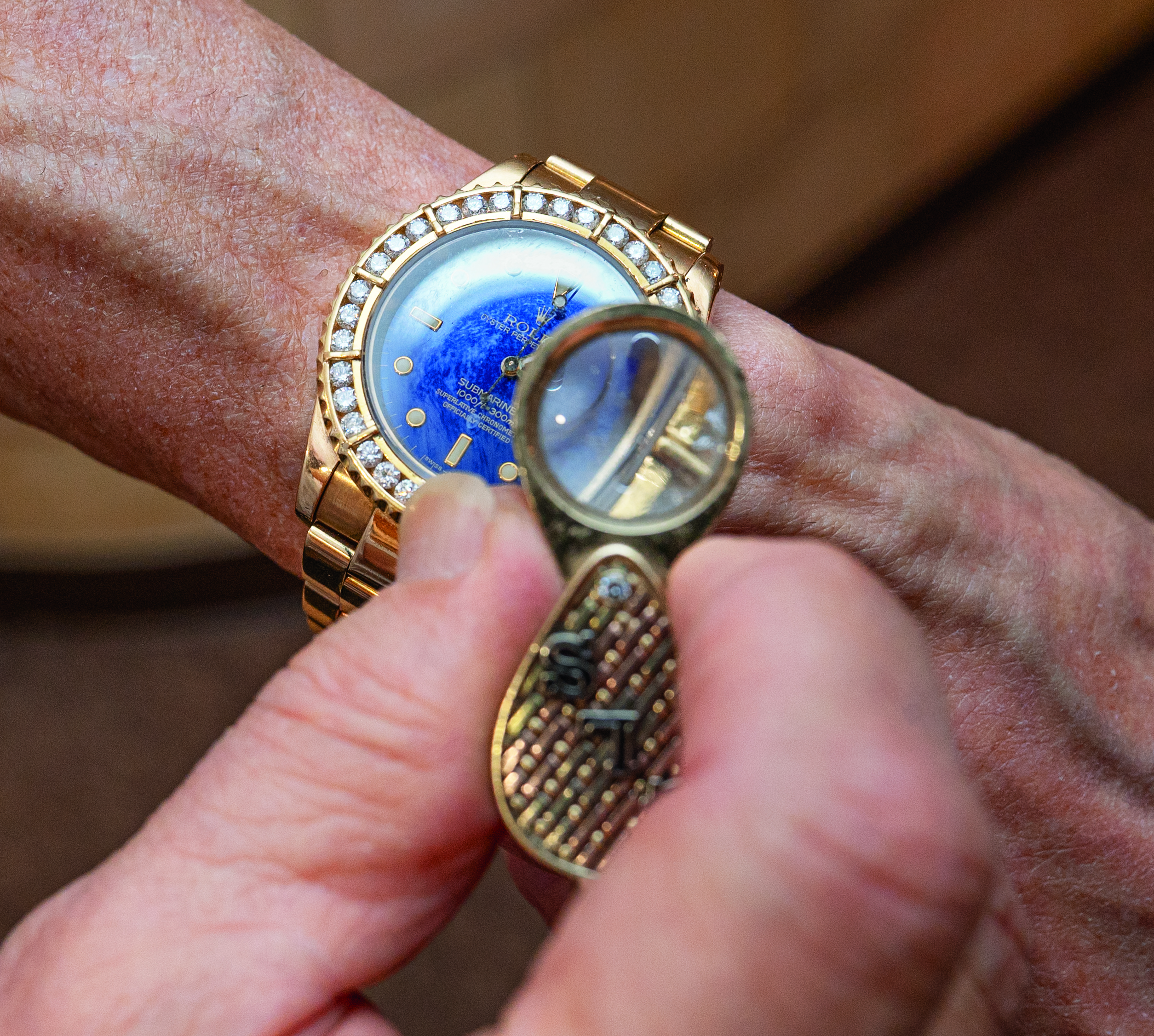
Smith’s accessories reflect his vocation. There’s a 24-carat gold chain draped around his neck. His wrists are enveloped in gold: a Rolex on the left and a bracelet on the right. Among his rings is a 4-carat diamond, given to him as a thank you gift from a satisfied customer.
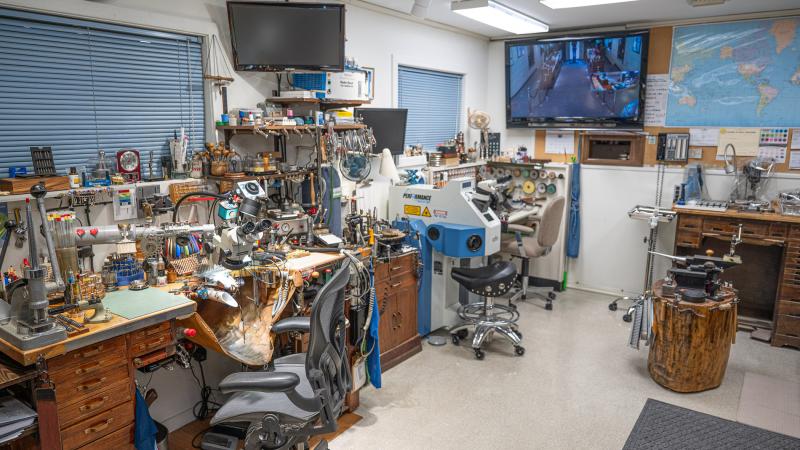
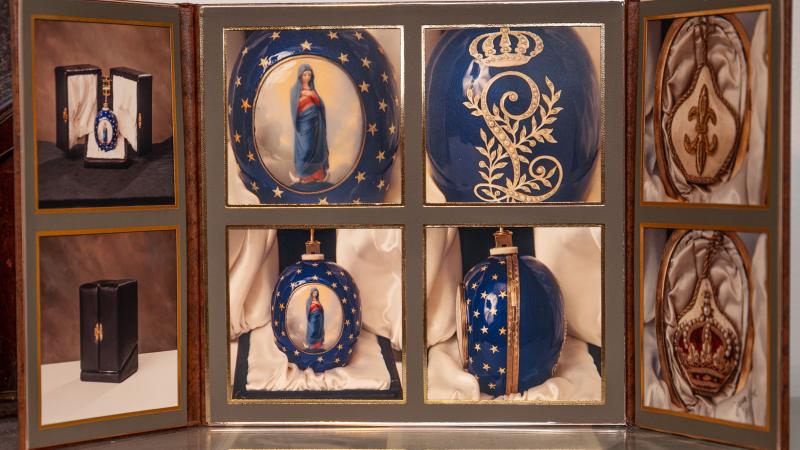
A large chunk of Smith’s time is spent in a lab devoted to countless repair and restoration projects, requiring his unique blend of historical expertise, dexterity and technical savvy. This is where he spent 36 hours enameling to repair gold that had been crushed on one of the 57 surviving Fabergé jeweled eggs made between 1885 and 1917, created a commissioned replica of an ornate watch key owned by George Washington, and restored gold work on an emerald ring recovered from the 1622 Nuestra Señora de Atocha shipwreck off Key West.
“I enjoy restoring the most. I’ll take something that one time was cherished and is almost ready to be destroyed, and I can bring it back to what it was like the day it was made,” Smith said. “And that way, it can be passed down. That’s my big joy, putting them back the way they were.”
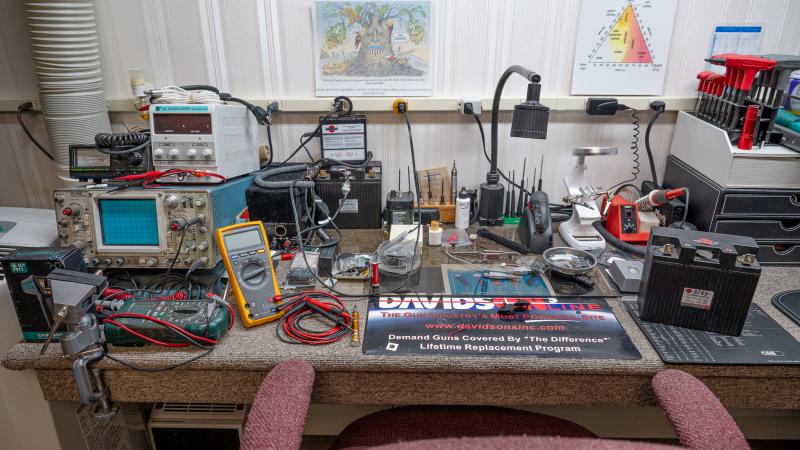
The lab is filled with techy tools befitting Tony Stark and his Iron Man persona. There is a trinocular microscope that captures miniscule details of jewelry. “We can zoom in on something so the customer can actually see what needs repaired,” Smith smiled. To the right is a laser welder so precise he can apply three welds to fit within the diameter equivalent of a strand of hair. “When I acquired it, I think there were only three of them in the country,” he said.
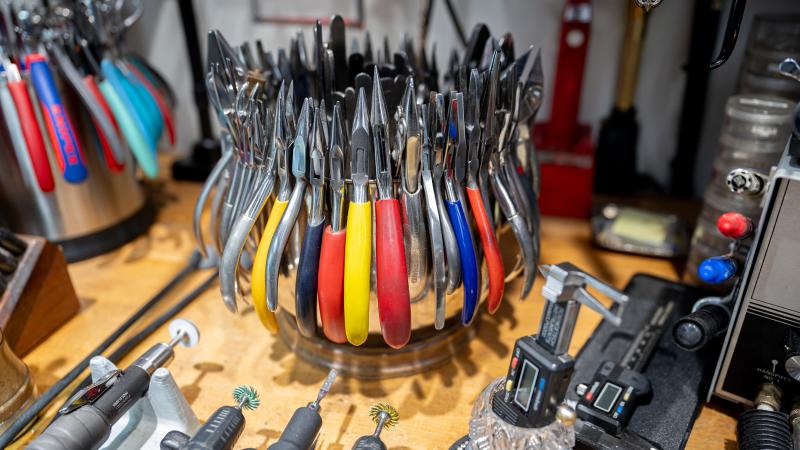
Behind him is an anvil with an elongated and sharp snout modeled after illustrations of the one belonging to Benvenuto Cellini, a renowned Italian goldsmith during the Renaissance. Nearby are watchmaker lathes and an electric casting machine. And the 150-plus pliers Smith has made or modified for diamond setting are impossible to ignore.
“I don’t have a single piece of equipment that I didn’t have a part in fixing or creating,” Smith said. “Almost everything I have, I’ve torn apart to change it and make it better.”
Tinkering has been a way of life for Smith since he was a child living across the street from the state police barracks in Montoursville, where his father worked as a trooper and photographer. “My mom said we didn’t have a clock in the house until I was about 14 because I was always taking them apart,” he laughed.
Studying electronics at WTI became Smith’s path after his uncle, an electronics engineer, gifted him a crystal radio kit. “When I turned it on and it actually worked, that was the hook,” he said. “How can this piece of crystal and a couple wires do this? That was the start of it.”
At WTI, Smith didn’t study in high-tech, clean labs that would later become the hallmark of Penn College, but the faculty made the best of limited resources. “Every instructor that I had, you knew they cared about you. If you had questions, you didn’t feel like you were a bother. You could go to them after class, and they would take the time,” he recalled.
Smith learned well. Minneapolis-Honeywell Regulator Co. in St. Petersburg, Florida, hired him after graduation to work on guided missiles. About a year later, his WTI education and electronics background caught the eye of the U.S. Army Security Agency, which recruited him for overseas service during the Vietnam War.
Cue the “Mission: Impossible” theme.
It’s only been about 10 years since the Army declassified some information about the ASA, which operated from 1945 to 1977. The agency specialized in cryptography and monitoring radio frequencies originating from Communist forces.
“Part of my job was to set up secure communications and use cryptography for the signal to go directly to the White House,” Smith said. “I was in direct communication with the White House on what was happening on the ground in Vietnam.”
In the mid-1960s, Smith served his nation at the Tan Son Nhut Air Base near Saigon before the ASA transferred him to Bad Aibling, Germany. There, he and his unit were stationed for a few years at an Air Force base, or as Smith described it – a “spy base” focusing on Eastern Bloc countries aligned with the Soviet Union.
During his downtime, Smith often ventured into town and eventually befriended a master goldsmith looking to pass on his knowledge. The elderly German found an eager apprentice.
I’ve always loved gemology and the fact that you can find something beautiful and potentially valuable hidden in the rocks and dirt.
“I’ve always loved gemology and the fact that you can find something beautiful and potentially valuable hidden in the rocks and dirt,” Smith said. With a wry smile, he recounted breaking his ankle as a young teen when a mountain of rocks collapsed under him in a quarry outside of Montoursville. What was he doing on top of the rocks? Chipping away at a bright specimen that he spotted through binoculars.
Smith studied the “old school” repair and restoration techniques mastered by his German mentor for about three years. “I learned on traditional tools and antique jewelry because he wouldn’t trust me with the new stuff,” Smith chuckled.
Many of the pieces were from the Victorian period (1837-1901), which remains Smith’s favorite era of jewelry. “The style features very fine workmanship. It’s not heavy and clunky like other periods in history,” he explained.
Following his discharge from the ASA in 1969, Smith returned to the Williamsport area, where he worked at Litton Industries Inc., a defense contractor. He also established Smith Jewelers in the basement of his home, offering personally made pieces and repair and restoration expertise learned in Germany.
“I did the diamond setting for all the local jewelers because nobody around here could set prongs,” he said.
When it came to his own diamonds, Smith often went directly to the source, traveling multiple times to West Africa and other remote locales, where he would purchase raw diamonds from indigenous miners. “Why should l pay markup when I could actually, with my knowledge and abilities, go right to the mine site?” he reasoned.
The lawless nature on the roads outside the mines often put Smith at risk, but he relied on his military training and personal weaponry for protection. “Sometimes it was a shoot-your-way-out kind of a deal,” he said, matter of factly. “One time we rented a new SUV, and by the time we brought it back a week later, there was no glass left, and there were bullet holes in it. The guy went ballistic.”
Reminders from those excursions are displayed in his office today, like his trusty knife and a whip that would make Indiana Jones envious. “When you cracked the whip, it was a good way to scare small animals away in the jungle,” Smith explained. Skin once belonging to a long snake extends on the side wall. African villagers gave it to him as a gift. “The snake was eating their goats,” he said. Among other keepsakes are a poison blow gun obtained in Brazil and a sword found in Damascus, Syria. And behind his desk is a deactivated hand grenade.
He didn’t have adequate space to display those and numerous other mementos from his escapades until he moved the jewelry business from his basement to its current location, which he purchased in 1982. In the ensuing years, he completed a slew of courses through the Gemological Institute of America and became a graduate gemologist before achieving “master” status and teaching classes for the GIA throughout North America.
“In goldsmithing, I can create, recreate, repair, restore, do just about anything. I don’t care what it’s made of. Gemology deals with gemstones, their properties and things of that nature. Coupling the two together is what started the PA Gem Lab, the forensic side of things,” he said.
The PA Gem Lab began in 1997, but Smith’s adventurous and entrepreneurial spirit led to many prior endeavors. He became a Pentecostal minister after crediting God for curing his infant daughter’s visual impairment. (In 2001, he opened New Covenant Full Gospel Church in the back portion of his building. The church continues to host Sunday services and Wednesday night prayer meetings.) Smith also worked as a dental technician, creating and repairing crowns and bridges. Small business ventures included a security-alarm company, an early internet service provider and a collaboration with Sony Corp. on an integrated computer video imaging system for jewelers.
But it’s the PA Gem Lab that’s provided the most recognition for Smith. Through that entity, he offers litigation support, consulting and expert witness testimony for clients, often focusing on forensic reconstruction and valuation of missing jewelry. His expertise is sought from people throughout the country and the world.
“For example, I can get a piece in from an estate, and the person is wondering if it’s original and the stone is natural. I can say, to the best of my opinion, the piece is original because the solder joints are a certain way, and it’s from a certain period because of the cut of the stone.”
A digital microscope that projects onto a huge flat-screen monitor allows Smith to pinpoint details to the hundredth of a millimeter on any stone. Another tool he employs is a toaster-size instrument called a PhosView, which shines an ultraviolet light to help distinguish between natural and lab-grown diamonds. If the diamond fluoresces a greenish color, it’s a less valuable lab-grown version. Of course, Smith’s 4-carat diamond ring glows a bit blue, not green.
Part of Smith’s international renown stems from a Guinness World Record. A few years ago, he authenticated in the PA Gem Lab the largest collection of natural saltwater pearls: 2,392. In what could be a subplot to the next “Pirates of the Caribbean” installment, the pearls belonged to a man whose late grandfather, an archeologist, discovered them in a pot buried at the high-water mark along the shoreline of an island. The owner of the pearls contacted Smith at a gem show in Arizona and later traveled to Montoursville for him to examine a sampling.
“I was blown away,” Smith said. “Those pearls are about as rare as they come.”
The estimated value of the collection, which dates back over 500 years, tops $10 million.
Such expertise is why Smith has trademarked the terms “forensic gemologist” and “forensic jeweler” to differentiate himself from others who might take a class or two and are tempted to pass themselves off as authorities. After all, they haven’t performed forensic services for the Smithsonian Natural History Museum like Smith has.
Through a friendship with Kimberly R. Cassel, college relations director, Smith has become reacquainted with the institution that jump-started his remarkable career. He’s toured parts of the campus and met instructors such as Howard W. Troup, associate professor of automated manufacturing and machining.
“You can sense whenever you’re on campus that every instructor will go out of their way for their students,” said Smith, whose grandson Zach J. Fisher is an electrical construction student at the college. “It’s a passion for them.”
Troup, along with Bryan C. Schaefer, instructor of CNC machining and automation, made Smith two hardened-steel tapered ring mandrels.
“Gary’s scope of accomplishments in such a specialized field are simply amazing,” Troup said. “He has been a trailblazer for a little known but important profession. I can only hope that I am as sharp and active at the age of 81 as he is.”
And that active lifestyle will continue for many more years, according to Smith. “I hope to make it until 110 unless a hang-gliding accident takes me out before then,” he said.
That would be quite an end to a memorable “movie.”
Share your comments
Penn College Magazine welcomes comments that are on topic and civil. Read our full disclaimer.
We love hearing from you